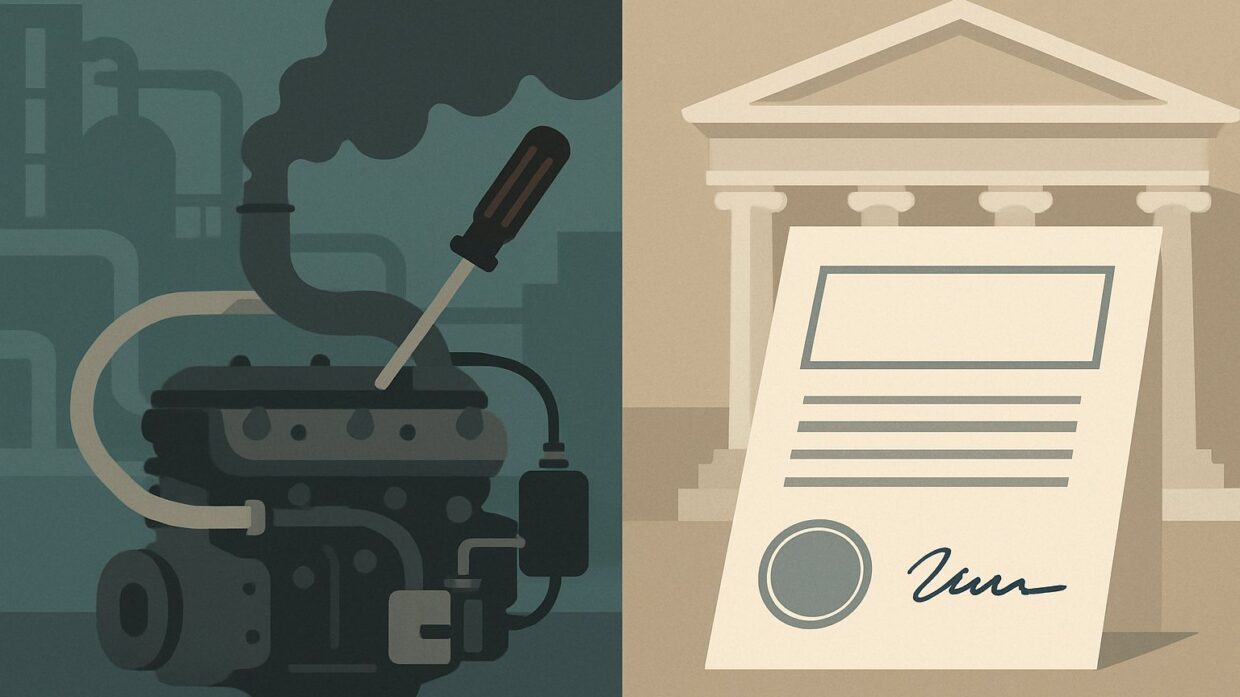
Photo: Well This Is News
Trump Grants Clemency to Emissions Cheaters and Lobbyist Allies in Latest Pardon Wave
Trump Pardons Diesel Engine Owners 'Persecuted' by Biden Administration for Vehicle Modifications
Trump Pardons Nine People Convicted of Clean Air Act Violations, One Former Abramoff Associate
Key Takeaways
- Neither side established whether the nine emission violators were actually Trump supporters or donors, or whether they were selected simply because Trump's team views them as wrongly prosecuted.
- The reporting does not clarify whether these nine Clean Air Act prosecutions were unusual outliers or consistent with decades of enforcement patterns under multiple administrations, making it impossible to assess if the pardon corrects injustice or sets a precedent that environmental law is politically negotiable.
- The factual details of what the defendants actually did remain unexamined in coverage from both sides: whether they were commercial operations or hobbyists, whether they voluntarily disclosed the violations or were discovered through inspection, and whether Trump's description of 'fixing a car' matches the substance of their convictions.
The Analysis
Trump issued pardons to nine people convicted of Clean Air Act violations involving diesel engine emission tampering, plus one former associate of disgraced lobbyist Jack Abramoff. The factual record is straightforward: these individuals were prosecuted under federal environmental law for modifying vehicles to defeat pollution control systems. What differs sharply is the frame each side applies to that fact, and what neither side addresses.
The left describes this as part of Trump's pattern of clemency for political allies, using language like "allies, public figures and those seen as politically aligned." HuffPost's framing emphasizes the category of recipient rather than the substance of the offense, treating the emission violations as incidental details within a larger narrative about partisan favoritism. This language choice leaves unexamined whether the nine emission violators were actually Trump supporters, campaign donors, or simply selected from a broader universe of people Trump's administration views as wrongly prosecuted. The reporting does not establish which.
The right frames this as Trump correcting what it characterizes as Biden administration persecution. Trump's statement, according to Fox News, was that the recipients were "persecuted by the Biden Administration" and punished for "fixing their car." This language redefines the offense. Modifying diesel engines to disable emissions controls is technically fixing a car, but it is also deliberate violation of the Clean Air Act, a law that has existed since 1970. Fox's framing accepts Trump's characterization without placing it in the context of what the Clean Air Act actually prohibits or why those prohibitions exist. The coverage does not establish whether these prosecutions were unusual, selective, or consistent with prior enforcement patterns.
What neither side addresses is the specific legal and factual basis for these convictions. The Clean Air Act prohibits tampering with emissions control equipment. The law has been enforced for decades across multiple administrations. The available reporting does not establish whether these nine cases were outliers in Biden-era enforcement, whether they involved commercial enterprises or individual hobbyists, whether they were prosecuted after voluntary disclosure or discovered through inspection, or whether Trump's characterization of the offense as simple "car fixing" is consistent with what the defendants actually did. These are not trivial omissions. They matter to assessing whether the pardon corrects an injustice or sets a precedent that environmental law enforcement is politically negotiable.
The Abramoff connection introduces a separate question. Jack Abramoff was convicted of conspiracy and fraud in one of the largest lobbying scandals in U.S. history. Trump's pardon of someone associated with that case invites scrutiny of whether the pardon is based on the merits of the underlying case or on other factors. The reporting does not clarify the nature of the connection or the substance of the original offense.
The underlying question is whether clemency power is being exercised on a consistent legal or factual basis, or whether it is becoming another instrument of political alignment. The available evidence does not yet establish which.
These pardons signal that enforcement of the Clean Air Act, a foundational environmental statute for five decades, now depends on political alignment rather than violation severity. If the nine diesel-tampering cases were routine prosecutions consistent with decades of enforcement practice, the pardons suggest future environmental violations will escape prosecution based on the perpetrator's political standing. If enforcement actually was selective or excessive, that determination requires factual proof neither side has provided. The Abramoff associate pardon compounds this by linking clemency to a figure from the most notorious lobbying corruption scandal in modern history, implying that prior conviction for schemes involving political influence no longer bars presidential favor. Without establishing whether these prosecutions deviated from historical patterns, Trump's actions either normalize environmental law as a political tool or evade accountability for that shift through selective use of power that corrupted lobbying networks have historically exploited.