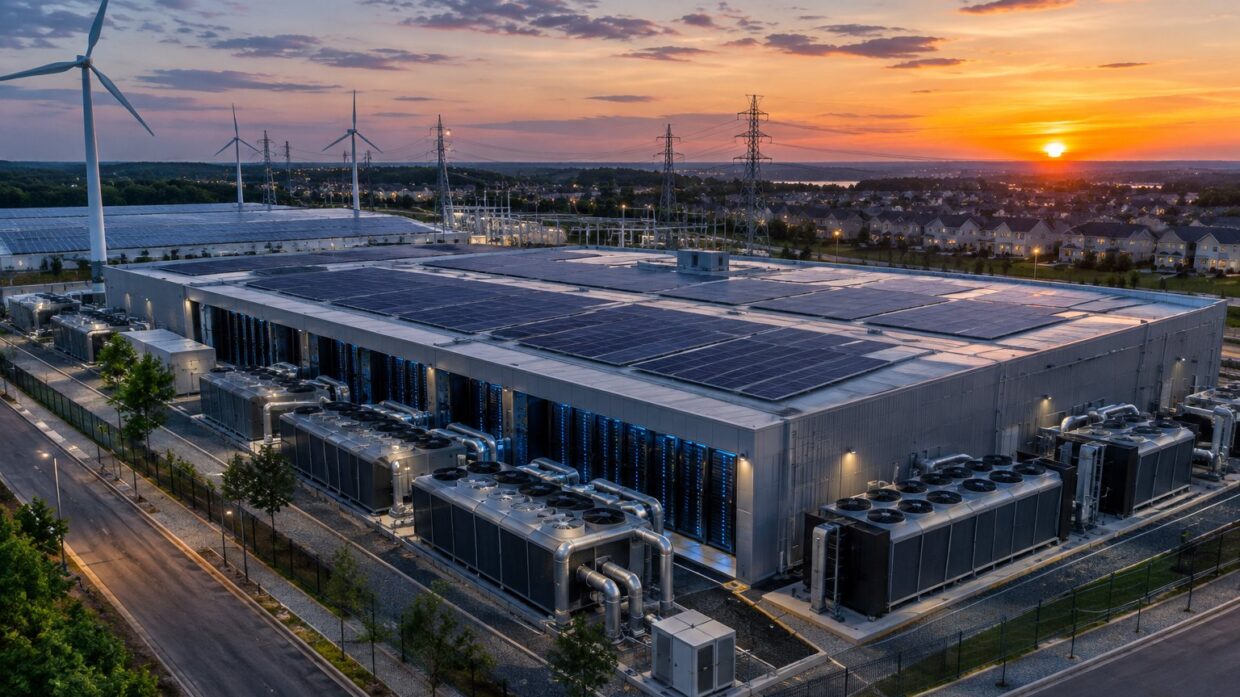
Photo: Well This Is News
Data Center Boom Becomes Global Crisis as Trump Shifts Burden to Tech Companies
We haven't found a right-leaning take on this story yet.
Breaking stories sometimes publish before every side has covered them. We'd rather show you that than invent a view.
Trump Orders Data Centers to Generate Own Power as Global Electricity Demand Surges
Key Takeaways
- Data centers have consumed large amounts of electricity for years, but AI adoption rates accelerated so rapidly that the infrastructure problem became visible and urgent only recently.
- Trump's mandate requires private power generation and grid sharing but does not address whether this redistributes the burden rather than solving it, such as shifting water scarcity problems in drought regions.
- The directive appears to impose new requirements on data centers without clarifying whether it conflicts with existing state-level contracts and incentives that previously attracted AI infrastructure investment.
The Analysis
Trump's data center directive targets a real infrastructure problem that neither utilities nor tech companies have solved. The requirement that data centers produce their own electricity and share excess power with neighboring communities addresses an immediate grid crisis: AI's explosive energy demand is straining local electrical systems faster than utilities can expand capacity. Trump's language was precise on this point, stating he had "been watching Data Centers very closely," which signals executive focus on a specific economic constraint rather than ideological objection to the technology itself.
The Atlantic's framing treats data centers as a new crisis of public visibility, describing infrastructure that "once flew under the radar" as now facing "national and global outrage." That account emphasizes the anger as unprecedented and justified, but it omits a crucial detail: what changed is not data center operation but AI adoption rates. Data centers have consumed large amounts of electricity for years. The visibility shift reflects demand-side acceleration, not supply-side discovery of a hidden problem. The Atlantic's emphasis on "outrage" is politically functional because it positions the conflict as grassroots resistance rather than a logistical constraint problem that markets and regulation can solve.
Trump's order appears designed to externalize the cost of expansion: rather than federal subsidy for grid infrastructure, tech companies must fund their own generation and distribution. This is consistent with a deregulatory approach that privileges private capital investment over government spending. One unaddressed question is whether requiring data centers to generate excess power for local grids actually solves the problem or merely redistributes it. If a data center generates its own power but requires massive water cooling in regions already facing drought, the infrastructure burden simply changes form. The mandate does not foreground that tradeoff.
What the reporting leaves out is the prior regulatory context. Data centers already operate under state and local permitting systems. Some states have explicitly attracted data center investment through tax incentives and streamlined permitting, treating AI infrastructure as economic development. Trump's mandate appears to impose new requirements retroactively without addressing whether existing contractual obligations or state-level agreements conflict with federal directive. The sequence raises questions about implementation and coordination that the available reporting does not establish.
The underlying structural issue is this: AI training and inference operations consume electricity at scales that match or exceed individual industries. Without coordinated expansion of generation and grid capacity, any single solution, whether private power generation or grid sharing, addresses symptoms, not capacity. Neither the left framing nor the right framing published here engages with the hard reality that AI infrastructure may require either massive public investment in grid modernization, negotiated reductions in AI training intensity, or both. The mandate signals that the administration views private generation as the solution. Whether that approach proves technically feasible and economically viable remains undisclosed.
Trump's data center directive reshapes the relationship between technology infrastructure and public utilities by converting a regulatory compliance problem into a private capital requirement. Data centers have consumed massive electricity for years, but AI's acceleration compressed what could have been a decade-long grid modernization into an immediate crisis. By mandating that data centers generate their own power and share excess capacity with local grids, the order transfers grid expansion costs from federal and state budgets directly to tech companies, establishing a precedent that critical infrastructure constraints can be solved through corporate investment rather than public spending. This matters because it determines whether future electricity-intensive industries face similar mandates, whether utilities retain control over distribution networks, and whether drought-stressed regions absorb the water and cooling costs of private generation systems. The actual implementation, including how existing state contracts interact with federal mandate and whether on-site generation proves technically viable in water-scarce areas, will define whether this model becomes standard industrial policy or remains a political gesture that redistributes