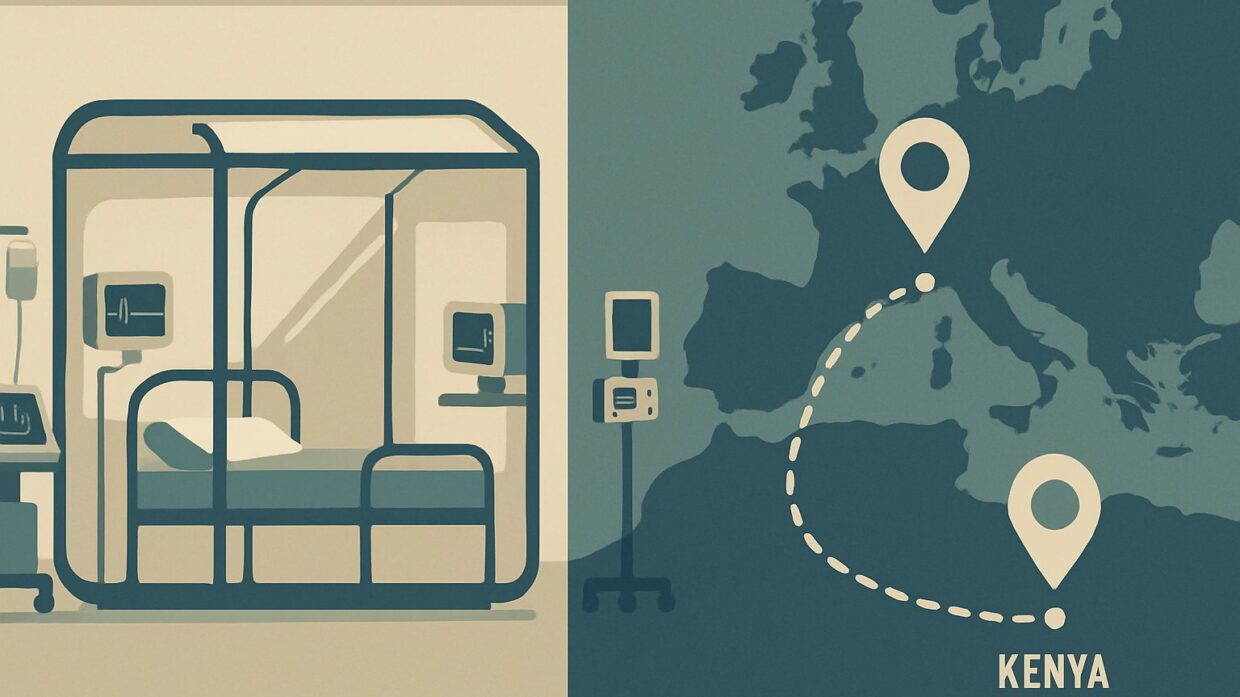
Photo: Well This Is News
Americans with Ebola denied return home under Trump policy, sent to Europe instead
New Trump rule: Americans exposed to Ebola won't return to U.S., quarantine in Kenya
Trump administration routes Americans with Ebola exposure to Kenya quarantine, Europe for treatment
Key Takeaways
- The administration has not publicly disclosed whether it assessed the capacity and medical standards of European treatment facilities or whether those facilities agreed to accept American Ebola patients.
- The policy abandons the precedent set by the 2014-2016 Ebola outbreak when the U.S. successfully treated American patients domestically, but no reporting explains why that domestic capability is no longer being used or whether it still exists.
- The cost difference between treating Ebola patients in the United States versus Europe, and the rationale for choosing Kenya specifically as a quarantine site, remain undisclosed to the public.
The Analysis
The Trump administration announced a policy Thursday that redirects Americans exposed to Ebola in Africa away from U.S. medical facilities, routing them instead through Kenya quarantine and European treatment centers. The specific mechanics matter: Americans exposed will initially quarantine in Kenya; only those who test positive move to European facilities. Neither the left nor right framing addresses what this arrangement actually costs, who pays it, or what medical standards govern the European facilities involved.
The documented facts are these. Senior Trump administration officials made the announcement. The policy applies to Americans "exposed to Ebola" who develop symptoms. A facility in Kenya will handle initial quarantine. European facilities will provide treatment if testing is positive. This represents a change from prior practice: the Obama and Biden administrations brought American Ebola patients home for treatment at specialized U.S. hospitals, including Emory University Hospital and the National Institutes of Health Clinical Center.
The left frame, led by NBC News, emphasizes denial and abandonment. The headline states Americans "will go to Europe for treatment, not U.S., officials say." The framing treats this as a closing of doors, a reversal of established care protocols. What this frame leaves out: the actual medical case for or against treating Ebola patients in European facilities versus American ones. It does not establish whether European treatment capacity exceeds U.S. capacity, whether European protocols are inferior, or what the administration's stated rationale was beyond the fact that officials said it would happen. The omission serves a narrative: this is punitive policy, not epidemiological strategy.
The right frame, via The Daily Wire, emphasizes control and boundary enforcement. The language shifts to "will not be permitted to return" and describes the policy as a "new rule" that "drops" for exposed Americans. This framing treats the policy as a security measure, a clarification of who gets access to U.S. territory and under what conditions. What this frame underplays: the fact that these are American citizens, the medical implications of routing sick patients across continents, and the prior precedent of bringing Americans home. The emphasis shifts focus away from care logistics toward immigration-style gatekeeping.
What neither side addresses directly is the prior record. The 2014-2016 Ebola outbreak saw the U.S. successfully treat American patients at home. Those cases established both precedent and capability. No reporting explains why that capability is no longer being used, or whether it still exists. The administration has not disclosed the cost differential between domestic and European treatment, whether European facilities agreed to this arrangement, or what informed the decision to use Kenya as a quarantine site rather than U.S. territory. The public record does not establish whether this reflects confidence in European medical protocols or a deliberate choice to treat Ebola exposure as an immigration issue rather than a medical one.
The underlying question is whether this policy reflects medical judgment or political framework. A complete picture requires answers that the available reporting does not provide: the administration's stated epidemiological or logistical reasoning, the capacity and standards of the European facilities involved, and whether American treatment capability was assessed and rejected or simply not considered. Until those specifics surface, the policy sits in interpretive space, claimed as both rational resource allocation and abandonment depending on which frame the reader trusts.
Rerouting American Ebola patients away from established U.S. treatment centers at Emory and NIH reverses a clinically validated precedent from 2014-2016 and dismantles institutional expertise built specifically for high-containment viral cases. This matters because specialized biosafety level 4 capacity takes years to develop and maintain; once closed or deprioritized, rebuilding it becomes exponentially harder if future outbreaks demand rapid domestic surge capacity. The policy also establishes a framework treating infectious disease exposure primarily as a border-control problem rather than a medical emergency, reshaping how federal agencies will allocate resources during the next major outbreak. Whether deliberate or accidental, this choice degrades American pandemic response architecture at a moment when that infrastructure faces unprecedented strain.