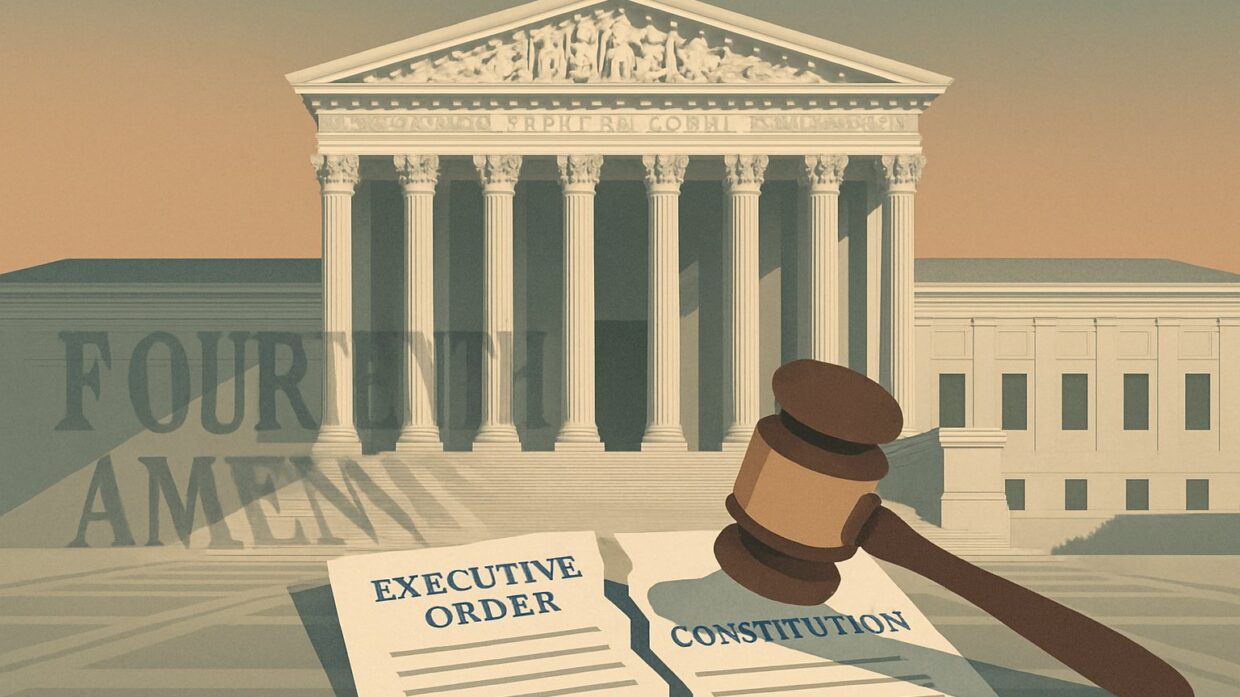
Photo: Well This Is News
Supreme Court firmly rejects Trump's attack on birthright citizenship
Trump suffers major Supreme Court defeat on birthright citizenship agenda
Supreme Court upholds birthright citizenship, blocks Trump executive order in 5-4 ruling
Key Takeaways
- Trump's executive order attempted to overturn a 128-year-old Supreme Court precedent from Wong Kim Ark rather than settle a new constitutional question.
- The 5-4 decision establishes that presidents cannot unilaterally reinterpret settled constitutional law through executive action, but leaves open whether a different Court composition could reach a different outcome.
- Neither side acknowledged that the Court simply reaffirmed longstanding law rather than engaging in novel constitutional reasoning to protect a newly vulnerable right.
The Analysis
The Supreme Court blocked Trump's executive order on birthright citizenship with a 5-4 vote, but both sides of the coverage are framing the same ruling in ways that obscure what the decision actually establishes and what it deliberately leaves unanswered about presidential power.
The facts: Trump issued an executive order on his first day in office seeking to end the automatic grant of citizenship to children born in the United States to non-citizen parents. The order relied on a narrow interpretation of the 14th Amendment that has been rejected by every prior Supreme Court reading of that clause. The Court voted 5-4 to reject the order. The ruling was issued on Tuesday, June 30, 2026. That is what happened.
The left's framing emphasizes constitutional principle and celebrates the outcome. NPR describes the decision as one that "firmly rejected" the order "on constitutional grounds." MSNBC reports on crowds cheering outside the courthouse and describes the ruling as delivering "a major blow" to Trump. Mother Jones and similar outlets frame this as Trump losing his "campaign to take control" of immigration policy. The language here is emotionally weighted, but it does acknowledge what the decision was about. What the left coverage leaves out entirely is the underlying constitutional question that Trump was actually raising: whether the 14th Amendment's citizenship clause applies to all children born on U.S. soil regardless of parental immigration status. The coverage frames this as settled, but the 5-4 vote suggests the legal question itself is contested among the justices. The omission shifts attention away from the genuine constitutional debate and toward the political outcome.
The right's framing accepts the outcome but emphasizes the margin and the loss. Fox News and The Daily Wire describe it as a "major defeat" and a "significant setback," language that is factually accurate about Trump's objective but frames the ruling as anomalous or unfair because it was close. The Federalist goes further, using the Cook decision to argue that Chief Justice Roberts is inconsistent about presidential power, claiming he expands it in some cases and restricts it in others. This framing identifies a real question about the Court's doctrine but does so selectively. The right largely does not engage with the constitutional reasoning for the decision itself, preferring to emphasize that Trump lost.
What neither side addresses is the prior legal baseline. The 14th Amendment's citizenship clause, ratified in 1868, has been read since United States v. Wong Kim Ark in 1898 to grant birthright citizenship to virtually all persons born on U.S. soil. Trump's executive order attempted to overturn a 128-year-old precedent through executive action. The Supreme Court's rejection of that order affirms the precedent but does not require any new constitutional reasoning. That context matters because it frames the case not as a novel judicial defense of rights but as a straightforward reaffirmation of long-standing law. Neither the left's celebration nor the right's framing of this as a surprise loss captures that basic fact.
The significance is institutional: the ruling establishes that executive power does not extend to unilaterally reinterpreting settled constitutional law through executive order, at least not on a 5-4 bench. What remains unresolved is whether a future president with a different Court composition could achieve the same policy objective. The close vote suggests the legal theory behind the challenge had some judicial support, even if not a majority.
The Supreme Court's decision protects a 128-year-old precedent but does not settle whether birthright citizenship is constitutionally untouchable. The 5-4 margin reveals genuine disagreement among justices about whether the 14th Amendment's citizenship clause admits of any restrictive interpretation, meaning a future administration with a reconstituted Court could revive the legal challenge with better odds. This ruling blocks one executive order but establishes no permanent barrier to executive reinterpretation of constitutional text on immigration. The real institutional consequence is narrower and more fragile than either side's coverage suggests: for now, on this bench, settled law cannot be overturned by executive order alone.