Photo: Well This Is News
Supreme Court strips voting protections, hands GOP redistricting victories in Texas and Virginia
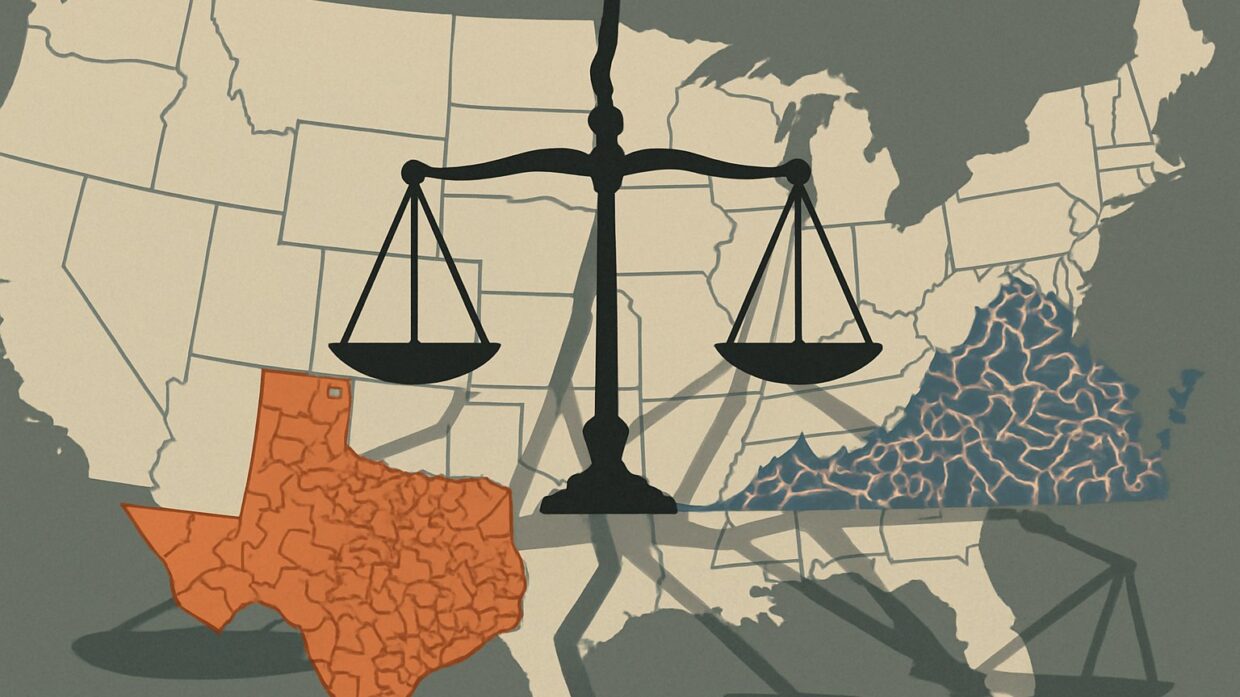
Supreme Court upholds GOP redistricting maps, rejects lower court challenges to Texas congressional districts
Supreme Court blocks lower court redistricting decisions in Texas, hears Virginia GOP challenge
Key Takeaways
- The Supreme Court reversed a 2022 lower court ruling blocking Texas's map without issuing a full written opinion explaining why the lower court's Voting Rights Act analysis was wrong, leaving the legal reasoning invisible.
- Virginia voters approved a 2020 constitutional amendment specifically to strip the legislature of redistricting power, but Republicans are now challenging whether that amendment was properly applied through the referendum process.
- The two cases reveal an asymmetry in how courts treat redistricting: the Supreme Court shields legislative maps from judicial second-guessing while remaining unclear whether voter-approved alternatives have equal protection.
The Analysis
The Supreme Court reversed a lower court's racial gerrymander ruling on Texas's congressional map on Monday while Virginia's state Supreme Court heard arguments on a Republican challenge to a newly approved redistricting plan, but neither news outlet adequately explained what triggered these competing legal battles or the prior decisions each side is now fighting over.
In Texas, the Supreme Court formally reinstated the state legislature's 2021 redistricting map after a lower court had blocked it in 2022, finding it violated the Voting Rights Act by diluting minority voting strength in Congressional District 23. The justices overturned that finding without issuing a full written opinion on the merits. In Virginia, the state Supreme Court heard oral arguments on Republican claims that a September 2023 voters' referendum approving a new congressional map violated state constitutional procedures, with Democrats defending that same map as correcting Republican gerrymandering from the previous decade.
Left-leaning outlets like MSNBC framed the Texas decision as "handing the GOP a redistricting win" and part of "a series of cases on how cellphone technology interacts with the Constitution," language that collapses two entirely different Supreme Court dockets into one narrative. This framing obscures the specific legal question: whether the lower court correctly applied the Voting Rights Act to find racial dilution, or whether the Supreme Court's shift on voting rights law made that lower court ruling obsolete. The left omits that the same Supreme Court majority, in Shelby County v. Holder (2013), had already gutted preclearance requirements under the Voting Rights Act, making the 2022 lower court ruling legally vulnerable from the moment it was issued.
Right-leaning outlets like Fox News called the Texas decision a "victory" and described it as striking down an "activist" lower court ruling. The Washington Examiner's headline stated the Court "allows Texas's pro-GOP redistricting to stand," explicitly naming the partisan beneficiary. This language frames the lower court as obstructionist rather than engaging the actual legal dispute. The right omits that Texas Democrats challenged the map specifically because it reduced Latino voting power in a state where Latino population growth far exceeded white population growth between the 2010 and 2020 censuses, and that the lower court's factual findings on dilution were never addressed on the merits.
Neither side explains the actual sequence: In 2013, the Supreme Court gutted the Voting Rights Act's preclearance mechanism in Shelby County. By 2021, Texas Republicans passed a new map. In 2022, a lower court applied remaining Voting Rights Act protections and blocked it. In 2024, a transformed Supreme Court reversed that lower court without full briefing. The real story is not whether the Court "won" or "lost," but that voting rights enforcement has collapsed through a series of Supreme Court decisions, and this Texas case is merely the latest application of that collapse.
The Virginia case reveals a parallel dynamic: Republicans are attacking a map approved by voters through referendum, arguing procedural violations. Democrats note that Virginia's previous Republican-drawn map had given the GOP 7 of 11 House seats despite Virginia voting blue statewide. Neither outlet adequately reported that Virginia's voters, in 2020, approved a constitutional amendment specifically to override the legislature's redistricting power. Republicans are now challenging that amendment's application.
What both sides omit: The two cases together show a complete inversion of redistricting power. The Supreme Court now protects legislative maps from judicial review while staying silent on whether voter-approved alternatives can stand. The real headline is that redistricting authority is consolidating in legislatures and away from courts and voters alike, and the Supreme Court is choosing which direction to look.
The Supreme Court is systematically dismantling voting rights enforcement and judicial oversight of redistricting while tacitly empowering legislatures to control their own electoral maps, a shift that will reshape American political competition for the next decade regardless of which party currently benefits.