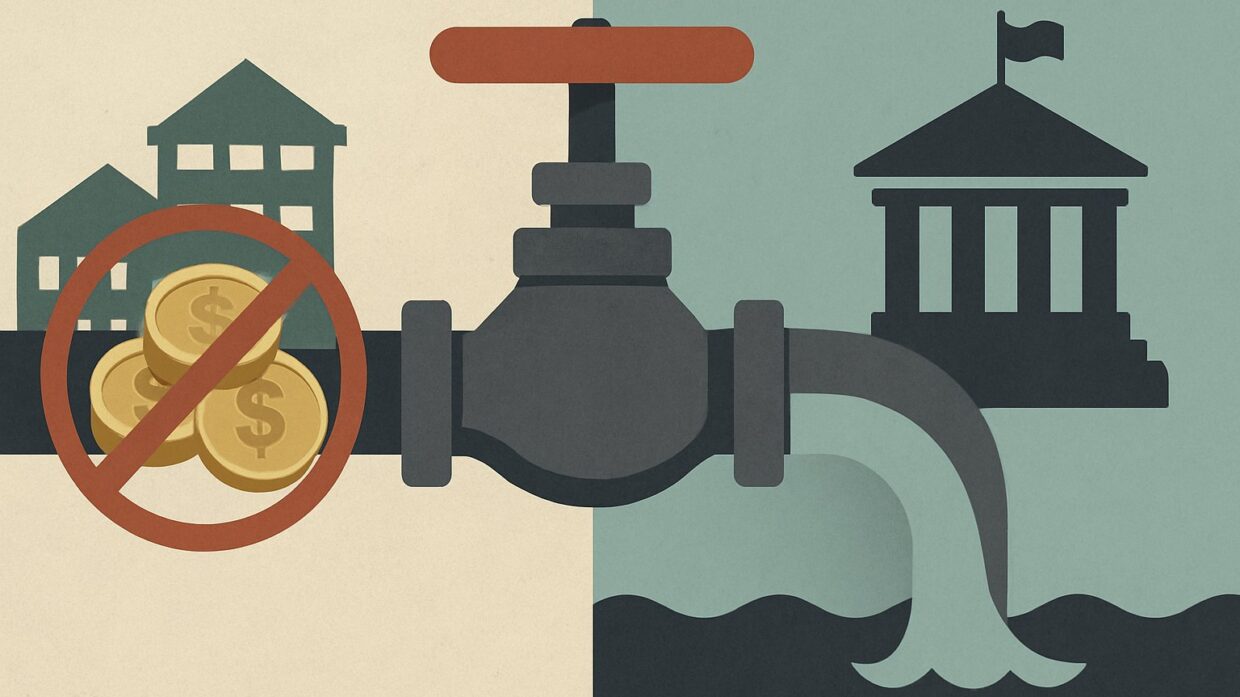
Photo: Well This Is News
Cross-party MPs demand government seizes control of Thames Water from US hedge funds
Politicians push to block private rescue of Thames Water with emergency takeover bid
MPs call for government takeover of Thames Water as rescue deal with US hedge funds faces scrutiny
Key Takeaways
- Public ownership would transfer Thames Water's estimated 15 billion pounds in debt to the public balance sheet rather than eliminating it, raising the question of whether changing ownership actually solves the underlying capital problem.
- The regulatory framework that has governed Thames Water since 1989 allowed the company to pay significant dividends while underinvesting in sewage infrastructure, but neither public nor private ownership models address whether this framework itself can balance profit incentives with necessary infrastructure spending.
- The real question is not whether ownership should be public or private, but whether either path will actually produce the capital investment the company needs.
The Analysis
Thames Water faces a choice between two competing rescue models, and an unlikely cross-party coalition of MPs is attempting to force that choice toward public ownership. The EFRA committee has recommended that the government reject the current negotiations with US hedge funds and instead invoke emergency legislation to place the company under special administration. What makes this significant is not the recommendation itself, but the political pressure that generated it,and what both sides are emphasizing versus omitting.
The documented facts are these: Thames Water is the UK's largest water and wastewater company, serving 15 million customers. It is heavily indebted, faces significant infrastructure investment requirements, and cannot secure private capital on acceptable terms. The government has allowed negotiations with US hedge funds, including investment groups such as Circularity Capital and others. MPs argue that these negotiations should be abandoned in favor of public control. The EFRA committee has published a formal report to this effect. No legislation has yet been passed, and the government has not committed to this course of action.
The left framing, evident in The Guardian's coverage, emphasizes foreign ownership and privatization as the problem. The language used is direct: the hedge funds are described as "attempting to take control," implying agency and intent to extract rather than stabilize. What this frame leaves out is the question of whether public ownership solves the underlying capital problem. Thames Water's debt is estimated at around £15 billion. Public ownership does not eliminate that debt; it transfers it to the public balance sheet. The framing also does not foreground how long public administration of utilities has typically taken or what costs accumulate during extended special administration regimes.
The right framing, evident in BBC reporting, tends to emphasize accountability and control rather than ownership ideology. The language is more neutral,"rescue deal" rather than "takeover," "hedge funds" rather than "foreign investors." What this frame underplays is the material reality that private rescue negotiations have repeatedly failed to produce acceptable terms. If private buyers are not willing to invest without extracting returns, that is a fact about market incentives, not a preference that can be argued away.
What neither side fully captures is the history of this company's regulation and the specific failures that produced this crisis. Thames Water has been privately owned since 1989, regulated under a framework designed to balance profit incentives with service obligations. The company paid significant dividends while underinvesting in sewage infrastructure, a dynamic that appears consistent across multiple UK water companies. The question is not simply whether ownership should be public or private, but whether the regulatory framework itself allows profitable operation while meeting the infrastructure investment needs England's water system actually requires. That question is largely absent from both framings.
The public record does not yet establish whether the government will accept the EFRA committee's recommendation or allow negotiations with hedge funds to continue. The material issue is whether either path produces the capital investment the company needs. Public ownership does not automatically solve that problem any more than private ownership guarantees extractive behavior.
The Thames Water crisis exposes a regulatory failure that transcends ownership ideology. For 35 years, the privatized framework allowed the company to distribute billions in dividends while infrastructure deteriorated, creating the £15 billion debt now threatening service to 15 million customers. Whether the government chooses public administration or hedge fund rescue, neither option addresses the core problem: England's water regulation permits profitable operation without mandating adequate capital reinvestment. The EFRA committee's recommendation avoids this harder question entirely. Whatever ownership structure emerges will require fundamental restructuring of how water utilities balance returns against infrastructure obligations, or this crisis simply transfers the accumulating costs to the next decade.