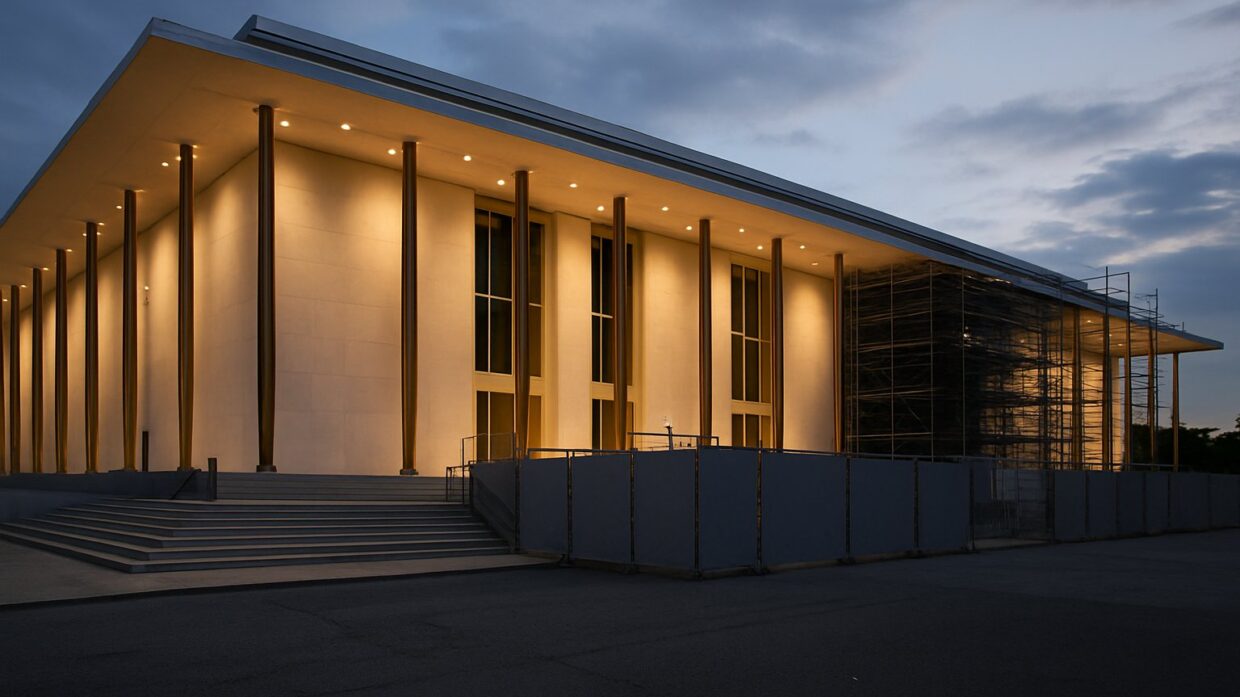
Photo: Well This Is News
Kennedy Center board votes to restore Trump's name while shutting down for repairs
Kennedy Center board restores Trump's name to venue facade, testing judge's limits
Kennedy Center board votes to close for renovations, adds Trump name to facade
Key Takeaways
- The Kennedy Center's naming history shows Trump's name was added in 2020, removed by court order, and is now proposed for restoration, making this a reversal of a reversal under judicial constraint rather than a routine naming decision.
- The two-year closure will cost the venue significant earned revenue and operational continuity, making the renovation economically substantial regardless of whether courts ultimately accept the board's legal theory about renovated structures.
- The board's legal argument depends on whether substantially renovated buildings fall outside prior naming injunctions, but the public record does not reveal whether Democratic board members opposed the vote, whether the Kennedy family was consulted, or what role the administration played in encouraging it.
The Analysis
The Kennedy Center board voted Thursday to close the performing arts venue for two years of renovations and to inscribe Trump's name on the facade as 'Restored and Renovated By President Donald J. Trump,' a direct assertion of institutional authority against a prior judicial ruling that had removed the name. What separates this from standard arts venue management is the explicit framing of the closure as legal cover for circumventing the court order.
The documented facts are these: A judge previously ruled that Trump's name could not appear on the Kennedy Center facade. The board voted Thursday to proceed with a two-year renovation and simultaneously voted to add the inscription tied to that renovation project. The Examiner reports the move is "testing the limits of a judge's order." No court has yet ruled on whether a substantially renovated building falls outside the scope of the prior injunction. The exact language matters: the inscription specifies "Restored and Renovated," which may provide the board's legal argument that a new physical structure justifies a new naming decision.
The left framing, visible in MSNBC and Atlantic coverage, emphasizes the word "again" and describes the strategy as deliberately circumventing judicial authority. Both outlets foreground the closure as political cover and highlight the appearance of executive pressure on an ostensibly independent cultural institution. The language choices reveal the interpretation: "brazen," "challenging," "testing the limits." What this framing leaves out is whether the board's legal theory has any merit, or what standard previous Kennedy Center naming decisions have actually followed.
The right framing, via the Examiner, leads with the board's institutional authority and frames the move as a legitimate assertion of the board's autonomy over naming decisions tied to capital projects it funds. The Examiner does not foreground the prior court order until deep in the story and presents the board's move as a reasonable legal question rather than institutional defiance. This framing leaves out the sequence: a court ruled, then the board voted to circumvent that ruling using a renovation as the mechanism.
What neither side fully captures is the prior naming history. The Kennedy Center has borne John F. Kennedy's name since 1971. Trump's name was added in 2020 under the Trump administration, then removed by court order, and now the board proposes to restore it. That sequence matters because it establishes this is not a routine naming decision but a reversal of a reversal under judicial constraint. The public record does not establish whether the board consulted the Kennedy family, whether Democratic board members opposed the move, or whether the administration played any role in encouraging the vote.
One institutional question remains unresolved: does a major renovation truly create a new building for purposes of prior naming injunctions, or is that reasoning legally transparent? The answer will determine whether the board has found a genuine loophole or constructed one the courts will reject. A second closure for two years will cost the venue significant earned revenue and operational continuity, making this economically substantial regardless of the legal outcome. What the board appears to be betting is that the renovation authority provides adequate legal distance from the prior ruling to survive judicial review.
The Kennedy Center board has created a legal test case that will determine whether major renovations can erase prior court orders restricting institutional naming. If courts rule the board's "substantially renovated building" theory valid, it establishes that any cultural institution can circumvent judicial naming decisions through capital projects, effectively nullifying the prior restraint. If courts reject it, the board faces reversal and potential sanctions for contempt. Either way, a two-year closure imposes concrete costs: lost ticket revenue, disrupted seasons, and staff displacement. The real institutional consequence is whether federal courts retain power to enforce naming restrictions against institutional actors willing to restructure physical assets to escape judicial authority.