Photo: Well This Is News
One Nation pushes divisive 750k migration cut as economy warns of damage; road deaths spark infrastructure debate
One Nation tackles migration crisis while Labor ignores infrastructure failures and judicial legacy fades
Australian politics spans multiple crises: migration cuts proposed, road safety questioned, justice figure dies
Key Takeaways
- One Nation's proposal would eliminate all net migration or move to negative levels, treating population supply as the root problem, but neither major party examined whether Australia's housing and infrastructure can actually absorb current migration rates or whether One Nation addresses genuine capacity limits.
- The Victorian road death sparked blame between Labor and Coalition without either side providing data on maintenance spending per kilometer or determining whether the crash reflects systematic neglect or isolated failure on that specific highway.
- Mary Gaudron left the High Court 23 years ago, yet her memorial coverage emphasized historical institutional progress rather than examining her actual intellectual legacy in contemporary legal debates around judicial independence or constitutional interpretation.
The Analysis
September 14, 2026 delivered three separate stories from Australian politics that each reveal how differently left and right frame the same underlying crises: what Left calls "divisive" Right calls "necessary," what Left calls "neglect" Right calls "unavoidable," and what Left elevates as institutional memory Right treats as historical footnote.
One Nation announced a policy to cut net migration by 750,000 annually, a figure that requires context. Australia's current net migration runs roughly 600,000 to 800,000 people per year according to Department of Home Affairs data. One Nation's proposal cuts to zero or negative territory, making it not an adjustment but a reversal. Labor's response used the word "damage," citing construction, healthcare, and agriculture impacts. The Coalition's response pattern suggests internal division: some members emphasized "economic harm," others said nothing. What neither major party addressed directly is whether Australia's infrastructure, particularly housing, can absorb current migration levels without continued price escalation, or whether One Nation's proposal addresses genuine capacity constraints or simply exploits current housing anxiety.
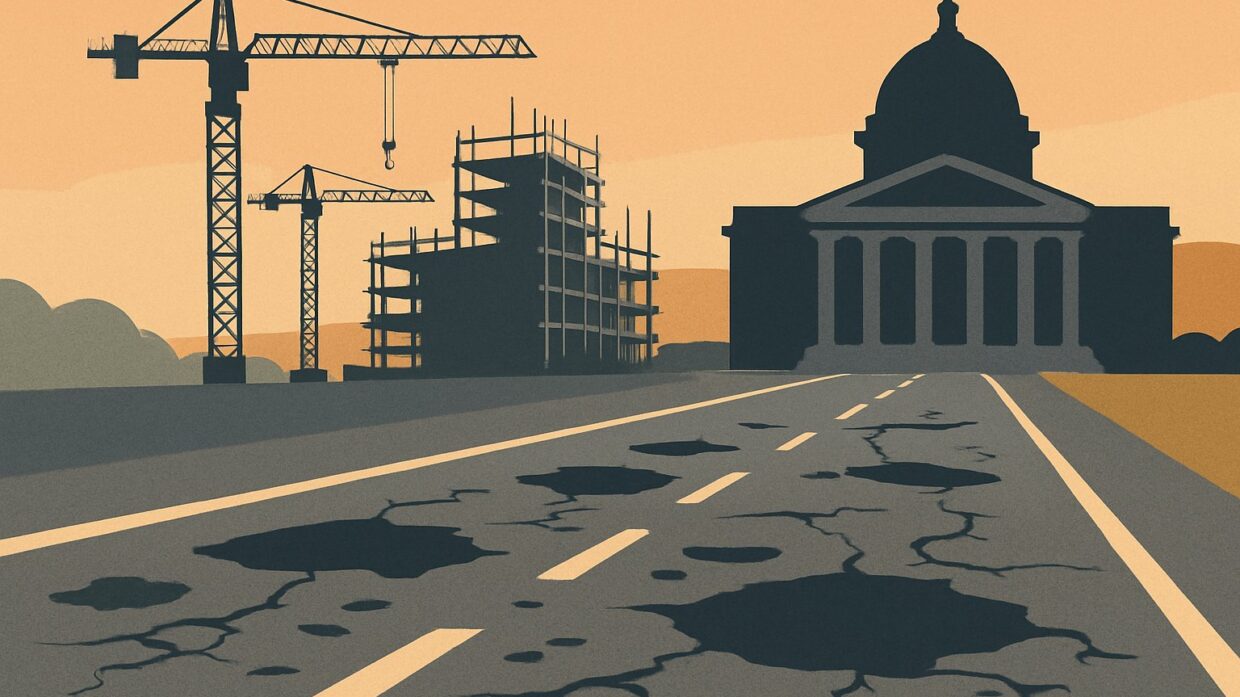
The motorcyclist's death on a Victorian pothole-damaged road near Trawalla illustrates infrastructure framing in miniature. A 71-year-old crashed and died on Western Highway on September 13. The Coalition called for fixes "as a matter of urgency." Labor's response, according to the live reporting, focused on broader road maintenance records. What neither framing quantified is maintenance spending per road kilometer under each government, or whether the Western Highway reflects systematic neglect or localized failure. The road safety argument became proxy for blame rather than diagnosis.
Mary Gaudron's death at 83 received memorial coverage emphasizing her role as "first female judge" and "champion of women in the workplace." The Guardian's framing centered institutional progress and equality advocacy. What the coverage left understated is that Gaudron served from 1987 to 2003, meaning her High Court tenure ended 23 years ago. Contemporary Australian legal debates around judicial independence, constitutional interpretation, or recent High Court decisions did not invoke her reasoning or legacy. She became a historical marker rather than an active intellectual figure in current jurisprudence.
The left frame across all three stories emphasizes damage, harm, and neglect. The right frame emphasizes necessity, capacity, and accountability. Neither addresses what connects them: Australia faces simultaneous pressures on housing, infrastructure, workforce, and public sector capacity. One Nation's migration cut treats supply as the problem. Labor's infrastructure emphasis treats investment as the answer. Coalition silence on all three suggests internal disagreement about whether these are genuine crises or political openings.
What the coverage does not establish is the actual relationship between migration levels and infrastructure failure, or whether road maintenance deterioration correlates to specific budget cuts or to deferred maintenance across administrations. The available reporting treats each crisis as isolated political event rather than system-level consequence.
Australia's simultaneous policy crises on migration, road safety, and institutional memory reveal a governing class discussing symptoms while avoiding diagnosis. One Nation's proposal to eliminate net migration treats housing scarcity as a supply problem solvable by exclusion rather than confronting whether infrastructure capacity matches current population flows. The motorcyclist's death on a deteriorated road became a blame game without establishing maintenance spending per kilometer or identifying systematic underfunding versus localized neglect. Mary Gaudron's passing was memorialized as historical progress while her 23-year-old judicial legacy went uninvoked in contemporary legal debates, suggesting institutional discontinuity in how courts engage constitutional questions. These three events expose that Australian politics lacks integrated infrastructure planning: no major party articulates whether housing, roads, and workforce capacity require coordinated investment, whether current migration levels are unsustainable given budget constraints, or how judicial continuity influences policy stability. The absence of this connection across news cycles permits