Photo: Well This Is News
Defense Secretary Hegseth reprimanded for laughing during solemn Veterans Day ceremony
Guard scolds Hegseth's group for disrupting Tomb of Unknown Soldier on Veterans Day
We haven't found a neutral take on this story yet.
Breaking stories sometimes publish before every side has covered them. We'd rather show you that than invent a view.
The Analysis
An Army sentinel interrupted Defense Secretary Pete Hegseth's group at the Tomb of the Unknown Soldier on Wednesday, instructing them to maintain atmospheric silence and respect after someone in the group laughed during a Veterans Day ceremony. The sentinel's action, captured on live television, raises a straightforward question about what actually happened and why the framing of that event has already diverged sharply across the political spectrum.
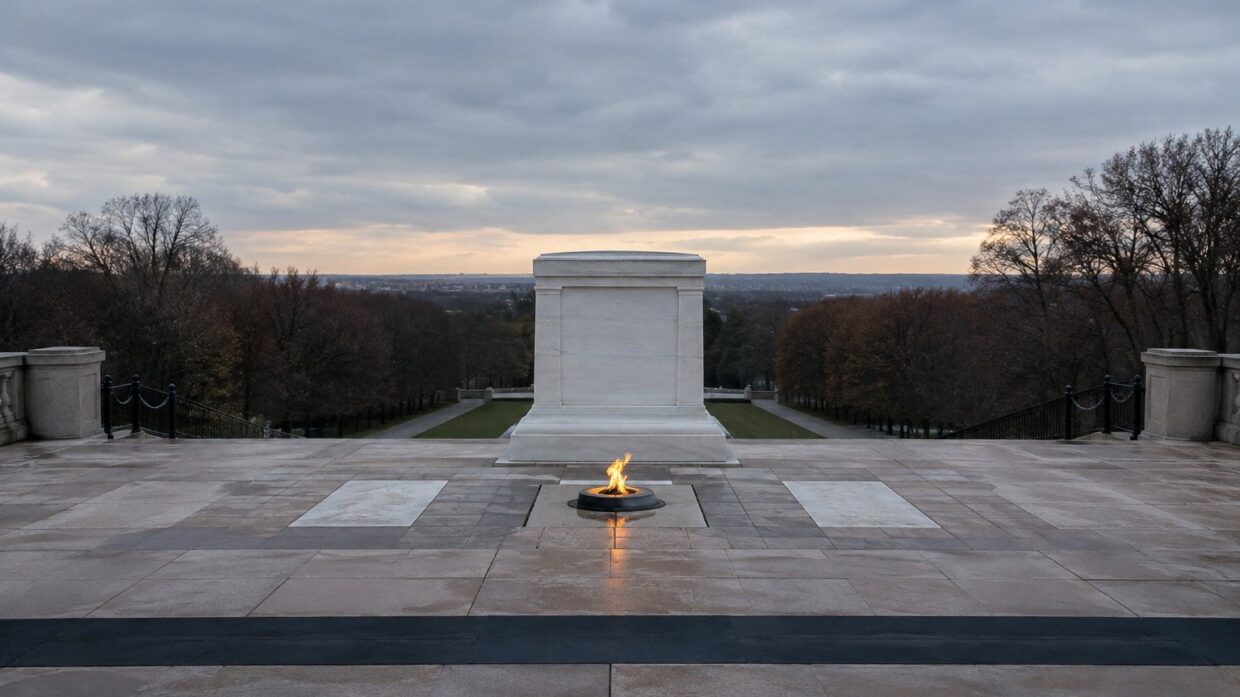
The verified facts are narrow. Hegseth, his wife, and members of his senior staff visited the Tomb of the Unknown Soldier during Veterans Day ceremonies at Arlington National Cemetery. The group was posing for photographs when laughter was audible. An Army sentinel, the uniformed soldier whose role is to maintain the ceremonial atmosphere of the memorial, stopped the group and delivered a public rebuke instructing them to maintain decorum. The incident occurred in front of live television cameras and is documented in video footage.
The left frame emphasizes Hegseth specifically and the solemnity breach. NBC News and HuffPost lead with "Hegseth was reprimanded," placing him as the subject and the reprimand as the lead consequence. That framing invites readers to ask: what does it say about the Defense Secretary that he requires correction from an enlisted sentinel about basic respect at a military memorial? The language choice, "rebuke," "reprimanded," "scolded", frames the sentinel's action as disciplinary rather than clarifying. The left coverage does not establish whether Hegseth himself laughed or whether he exercised control over the group, a detail that matters materially to assigning accountability.
The right frame emphasizes the entourage, not Hegseth, and uses neutral process language. The Washington Examiner leads with "Hegseth's entourage," softening individual accountability by distributing it across an unnamed group. The Examiner uses "rebuked" and "scolded", similar language to the left, but the subject construction keeps Hegseth at a distance from the violation. That frame shifts the question slightly: whose staff members were present and who specifically disrupted the ceremony? The right coverage also does not establish whether Hegseth issued a response or took corrective action with staff, details that might contextualize his awareness and control.
What neither frame foregrounds is the sentinel's actual role and why that role exists. Sentinels at the Tomb of the Unknown Soldier are members of the 3rd Infantry Regiment tasked with maintaining the ceremonial integrity of one of Arlington's most formal spaces. Their interventions are part of the protocol. A sentinel intervening to correct behavior is not extraordinary or unusual; it is the sentinel performing their assigned function. What is unusual is that the intervention occurred with a Cabinet-level official and his entourage during a televised event.
The public record does not establish whether Hegseth or members of his staff were unfamiliar with the specific decorum requirements at that location, whether the laughter was reflexive and unguarded rather than deliberate, or how Hegseth responded to the correction after the camera captured the initial moment. The absence of follow-up reporting on those details leaves open whether this represents a genuine breach of protocol or a routine application of protocol that acquired political significance because of who was involved and because cameras were present.
The real question is not whether the sentinel was correct to intervene, the protocol clearly gave the sentinel that authority, but what the incident signals about the distance between the Defense Secretary's awareness of ceremonial norms and the actual practice of those norms in real time.
Hegseth's position as Defense Secretary requires him to model military decorum at Arlington's most solemn venues, where sentinels enforce standards that apply uniformly regardless of rank. The public rebuke exposes a gap between understanding ceremonial protocol and executing it under pressure, with cameras present. More consequentially, it signals to enlisted personnel across the armed forces that even Cabinet officials face correction for breaches, which can either reinforce protocol consistency or create perception of unequal treatment depending on how Hegseth responds and whether his office addresses the incident internally. The moment crystallizes how presidential appointees' actions at military memorials set cultural expectations throughout the services about who enforces standards and whether those standards apply universally or bend for proximity to power.