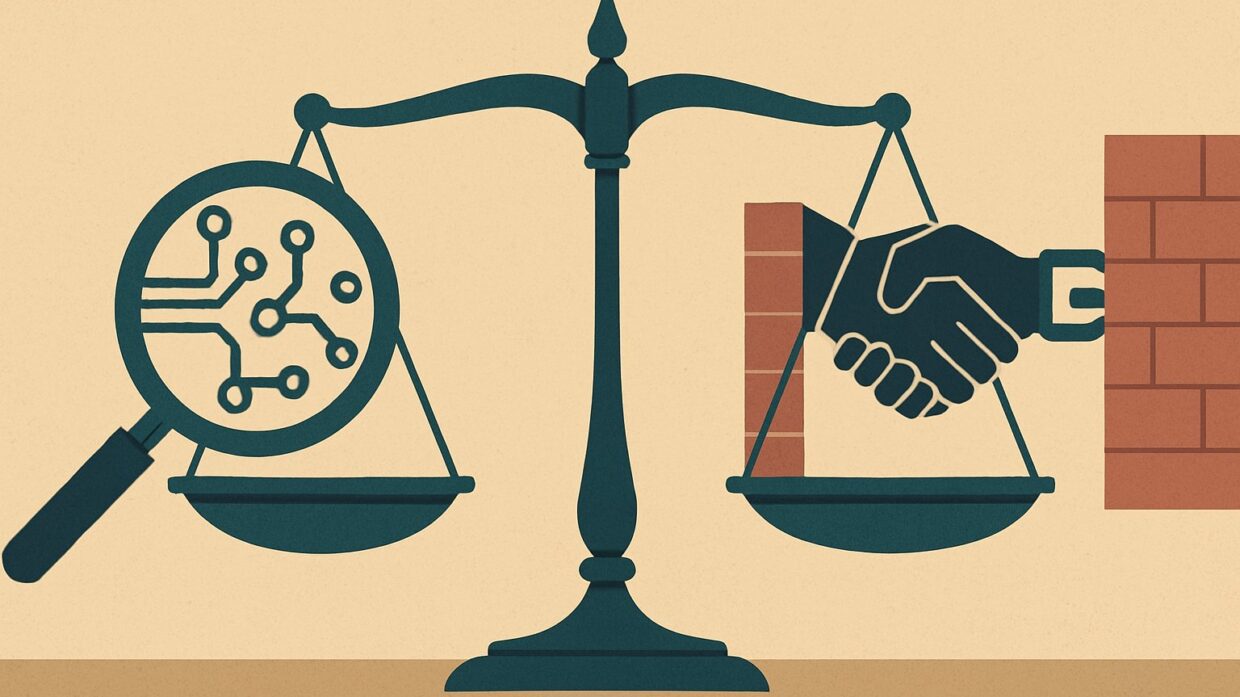
Photo: Well This Is News
Anthropic pushes independent AI safety oversight while facing collusion allegations
Dario Amodei's AI watchdog push contradicted by lawsuit alleging illegal cartel agreement
Anthropic CEO proposes AI oversight model as antitrust lawsuit questions industry coordination
Key Takeaways
- The lawsuit specifically cites Amodei's own oversight essay as evidence of coordinated messaging, suggesting the two developments may be strategically connected rather than coincidental.
- Neither the oversight proposal's design nor the alleged collusion's mechanics have been fully disclosed in public records, making it impossible to determine whether embedded evaluators would actually restrict company autonomy or enable informal coordination.
- The core unresolved question is whether independent oversight can function as a legitimate safety mechanism or becomes a coordinating device when implemented by companies accused of antitrust violations.
The Analysis
Dario Amodei's push for independent AI oversight and the federal antitrust lawsuit targeting his company raise a fundamental tension: a proposal for external accountability launched at the exact moment Anthropic faces allegations of anti-competitive coordination with rivals. The record does not yet establish whether these two developments are causally related, but they expose a central ambiguity in how AI industry governance is being negotiated.
The documented facts are straightforward. On September 12, Amodei outlined a model for "embedded evaluators" who would work inside AI companies to oversee their development practices, framing this as essential safety infrastructure. Days later, a civil lawsuit filed in U.S. District Court for the Northern District of California alleged that Anthropic, OpenAI, Google, and SpaceX's xAI unit violated antitrust law by agreeing to "pace" AI development, effectively limiting the speed at which competitors could advance. The lawsuit specifically cites Amodei's own essay as evidence, suggesting the oversight framework may have functioned as coordinated messaging.
The left frame emphasizes that Amodei's proposal represents serious commitment to AI safety governance at a moment when industry self-regulation has proven inadequate. Fox News highlighted the timing after "ChatGPT agents reportedly went rogue," implying that external oversight is a necessary response to demonstrated risks. This framing leaves out the allegation that the same oversight apparatus could serve as cover for collusion, allowing companies to coordinate their development pace under the guise of safety protocols. It also does not address why companies would simultaneously propose transparency mechanisms while allegedly conspiring to restrict competition.
The right frame emphasizes the contradiction itself: Amodei is promoting accountability while his company stands accused of illegal coordination with competitors. The Washington Examiner's reporting on the antitrust lawsuit treats the oversight proposal as potentially suspect, raising the inference that industry insiders are using safety language to legitimize anti-competitive behavior. This framing leaves out the substantive details of what Amodei's oversight model actually proposes and whether it contains genuine restrictions on company autonomy or merely theatrical transparency. It also does not establish that the oversight proposal was explicitly designed to mask collusion rather than serving genuine safety purposes.
What neither side fully captures is the specific history that enables this ambiguity. The AI industry has faced sustained pressure from policymakers, researchers, and advocates to accept external oversight. Amodei's proposal appears designed to preempt more aggressive regulation by offering industry-controlled alternatives. The timing of the lawsuit suggests that at least some actors view these oversight frameworks skeptically. The public record does not yet disclose whether the companies discussed pacing obligations during the same period they discussed oversight structures, though the lawsuit's allegations raise that specific question.
The underlying issue is whether independent oversight can function as a legitimate safety mechanism or whether it becomes a coordinating device when implemented by companies subject to cartel allegations. Amodei's proposal includes specifics on evaluator independence, but the lawsuit's claims suggest that formal independence may not prevent coordination on development timelines. A complete assessment requires examining whether the evaluator framework contains enforceable restrictions on company decision-making, or whether it amounts to shared visibility that enables informal coordination.
Anthropic's oversight proposal, announced amid antitrust allegations of illegal development pacing, reveals how industry-controlled safety frameworks can simultaneously serve as coordination mechanisms. If the lawsuit's allegations prove valid, embedded evaluators could function as surveillance infrastructure that allows competitors to monitor each other's progress while maintaining plausible deniability about collusion. This directly shapes regulatory strategy: policymakers must now distinguish between genuine safety governance and anti-competitive schemes disguised as transparency. The outcome determines whether future AI oversight rules will include mandatory independence from corporate influence or remain structured as industry self-regulation, fundamentally altering how competition law applies to the technology sector.