Photo: Well This Is News
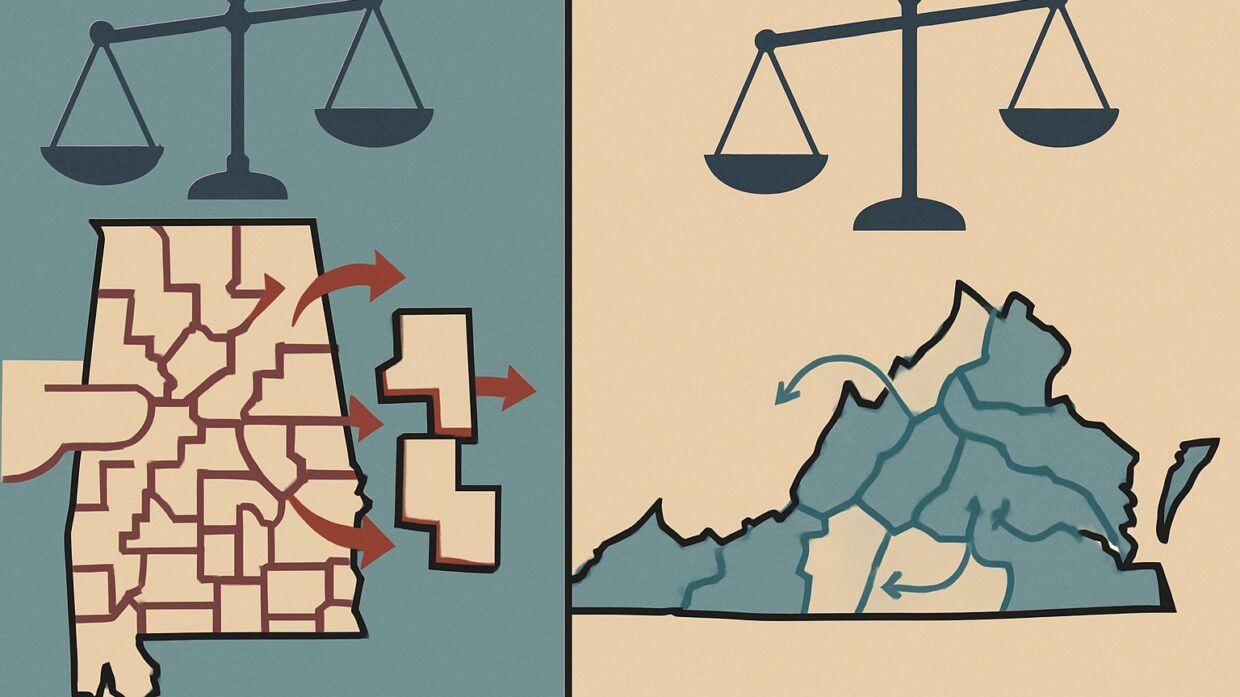
Supreme Court Backs Alabama GOP Effort to Eliminate Majority-Black Congressional District
Alabama Advances GOP-Favorable Map as Virginia Democrats Seek Federal Intervention on Gerrymander
Supreme Court Clears Alabama Redistricting While Virginia Democrats Challenge State Court Gerrymander Ruling
Key Takeaways
- Both Alabama Republicans and Virginia Democrats are using identical tactics to rush partisan maps through federal courts, yet each side claims the other is cheating while defending its own behavior.
- The Supreme Court's 2013 Shelby County decision removed preclearance requirements, making aggressive partisan mapping legally possible for whichever party moves fastest through federal courts rather than establishing any consistent principle.
- Without Section 5 voting rights protections, the Supreme Court itself has become the sole arbiter of which gerrymanders are permissible, creating a system where success depends on litigation speed rather than electoral fairness.
The Analysis
The Supreme Court's decision to accelerate Alabama's redistricting and simultaneous Democratic challenge to Virginia's court ruling expose the structural flaw both sides are quietly ignoring: the 2023 Shelby County voting rights decision didn't just make these maps possible, it made them inevitable.
What actually happened: On May 11, 2026, the Supreme Court lifted a freeze on Alabama's ability to adopt a congressional map that would reduce its Black-performing districts from two to one, concentrating Black voters into a single district that increases Republican seat totals statewide. The same week, Virginia Democrats filed for federal Supreme Court intervention after the Virginia Supreme Court blocked a Democratic proposal to redraw Virginia's 2nd Congressional District in ways that would have benefited Democratic candidates. Governor Kay Ivey signed legislation authorizing special primary elections once the federal court process cleared.
The left frames Alabama's map as explicit racial suppression. MSNBC's language, "eliminating a majority-Black district," emphasizes the erasure of Black electoral power and treats the outcome as dispositive evidence of racial intent. This framing is not wrong about the effect, but it conceals something crucial: it omits that the same justices who enabled Alabama also just blocked Virginia Democrats from doing precisely the same thing to Republican-leaning areas. The left's silence on Virginia suggests the complaint is not about gerrymandering itself, but about who benefits.
The right frames Alabama's decision as states' rights and proper legal process. The Federalist's framing, "Virginia Democrats Seek Supreme Court's Intervention over VA Supreme Court Gerrymander Ruling," implies federal overreach and Democratic hypocrisy. This is rhetorically clever but misleading: it treats Virginia Democrats' federal appeal as uniquely aggressive when Alabama Republicans were simultaneously accelerating their map through federal courts. The right omits that both sides are doing identical things and both sides are simultaneously arguing that their side should be allowed to win redistricting while the other side shouldn't.
What neither side names: In 2013, the Supreme Court gutted Section 5 of the Voting Rights Act in Shelby County v. Holder, which had required Southern states to get federal approval before changing voting procedures. That decision created the legal architecture for what's happening now. Alabama previously could not have drawn this map without federal permission. Now it can. Virginia's courts blocked the Democratic map, but Democrats believe they have a better shot with the federal Supreme Court, which has shown sympathy to Republican redistricting claims.
Both Alabama and Virginia are racing the same clock: election deadlines. Both are using federal courts to accelerate outcomes that benefit their party. Both are arguing that their mapmakers acted properly while the other side cheated. Neither is wrong about the other side's tactics. Both are wrong about their own.
The real headline: Two years after gutting voting rights protections, the Supreme Court is now the arbiter of which partisan gerrymanders are legally permissible, and both parties are learning it favors whichever side moves fastest through federal courts. The problem is not Alabama or Virginia. The problem is that voting rights law now has no principle, only velocity.
Alabama's map reduction from two Black-performing districts to one would not be legally possible without the 2013 Shelby County decision that eliminated federal preclearance requirements for Southern states. That same gutted framework now governs Virginia's Democratic redistricting challenge, meaning the Supreme Court has become the sole arbiter of partisan gerrymandering with no principled standard beyond which party reaches federal courts first. Both states are racing identical timelines to election deadlines, both deploying federal judges to accelerate partisan outcomes, yet Democrats attack Alabama's map as racial suppression while requesting identical federal intervention for Virginia advantage. The institutional consequence is stark: voting rights protection has shifted from preventing discrimination to determining whose discrimination moves fastest through litigation, converting the judiciary into a speed competition between parties rather than a check on either.