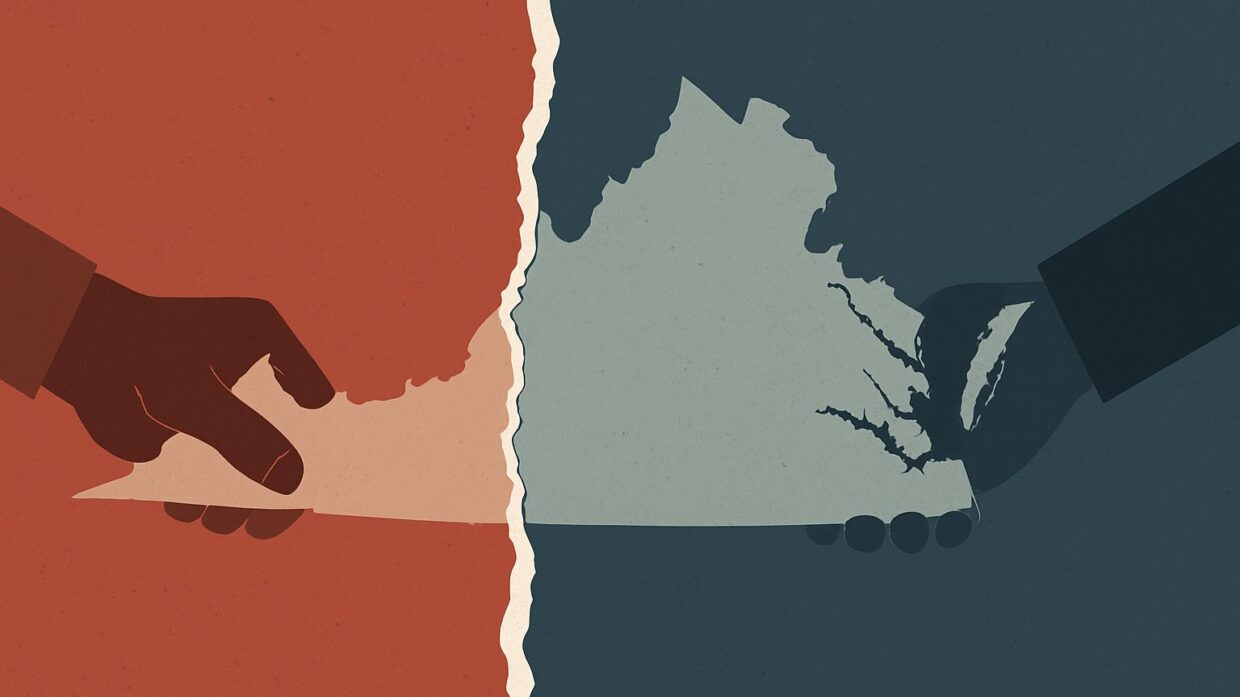
Photo: Well This Is News
Supreme Court empowers GOP redistricting push, weakening minority voting protections nationwide
Virginia court blocks Democratic map overreach, restores fair election process
Virginia Supreme Court voids Democratic redistricting map, setting stage for GOP gains in 2026
Key Takeaways
- Virginia state law requires that any struck-down map must be replaced, but neither party has explained who will draw the replacement map or by what standard, leaving the actual 2026 districts uncertain.
- The 2013 U.S. Supreme Court decision eliminating federal pre-clearance made this Virginia ruling possible by removing federal courts' ability to block state-court voting decisions before elections happen.
- If Virginia's legislature cannot agree on a replacement map, the state court itself must draw one, giving an elected court the same discretionary power both parties are fighting over.
The Analysis
Virginia's Supreme Court has voided a Democratic-drawn congressional map, but neither major party is telling you the full story of how the voting rights protections that enabled that map were systematically dismantled, or the state constitutional law that actually governs what happens next.
The facts: Virginia's Democratic-controlled legislature and governor approved a new congressional redistricting map in March 2024, replacing a map the U.S. Supreme Court had ruled violated the Voting Rights Act by cracking Black voting blocs across districts. That new map was designed to comply with federal law requiring protection of minority voting strength. On May 8, 2026, Virginia's Supreme Court declared it invalid, citing unspecified state constitutional violations. Republicans in Georgia, Alabama, and Texas have filed similar challenges or begun their own redistricting efforts.
The left frames this as a coordinated assault on voting rights. NPR explicitly connects the Virginia ruling to a "Supreme Court weakening minority voting rights," referring to a 2013 U.S. Supreme Court decision gutting the pre-clearance requirement of the Voting Rights Act, which for 50 years forced Southern states to get federal approval before changing voting rules. Without that requirement, NPR's logic goes, state courts can now strike down maps protecting minority voters without federal oversight. Kamala Harris used the phrase "ignored the will of the people," a rhetorical move that treats the legislature's map as equivalent to a popular vote, when in fact it was a legislative product subject to state constitutional review. This framing omits that Virginia's Supreme Court has authority to review legislative maps under the state constitution, not just federal law.
The right reframes the Virginia ruling as a court stopping an unconstitutional overreach. Fox News emphasizes Harris's use of the word "rig," then quotes her claim that Republicans are trying to "rig" the midterms, positioning the story as Democrats making unfounded accusations. This framing treats the court's decision as a simple restoration of proper procedure and ignores the consequence: that maps can now be invalidated without clear replacement criteria, creating uncertainty about what maps will actually be used in 2026.
What both sides are hiding: Virginia state law requires that any map struck down must be replaced, but neither side has explained who draws the replacement or by what standard. If Virginia's Republican-controlled Supreme Court strikes down the Democratic map and the legislature cannot agree on a replacement, the court itself must draw one. This has happened before. In 1992, after the U.S. Supreme Court struck down a Democratic map, Virginia's courts drew the map that governed elections for a decade. Neither party is discussing whether this court will use the same judicial discretion. Additionally, neither side acknowledges that the 2013 U.S. Supreme Court decision that eliminated pre-clearance was the pivot point: without it, federal courts cannot block state-court decisions about voting maps before elections occur. The Virginia decision only became possible because that federal protection no longer exists.
The real headline is this: A state court has voided voting protections the federal government no longer enforces, and no one is clearly explaining who controls the map that will actually be used in 2026 or by what standard it will be drawn.
Virginia's Supreme Court has eliminated the only voting protections that applied to the state's congressional districts, and the legal vacuum it created will likely be filled by the court itself drawing the replacement map. This matters because judicial redistricting is not neutral: when courts draw maps, they typically maximize electoral competition or defer to the party controlling the legislature. In Virginia's case, a Republican-controlled court drawing a map in a state where Democrats hold the governorship creates the practical possibility that neither democratically accountable branch can claim legitimate control over the districts that will determine representation for the next decade. The 2013 federal preclearance elimination removed the only external check on state courts making these decisions, meaning Virginia has shifted from federal oversight of minority voting protections to state judicial discretion with no clear standards. That shift will replicate in other states where similar challenges are pending. Republicans in Georgia, Alabama, and Texas are already following the same playbook.