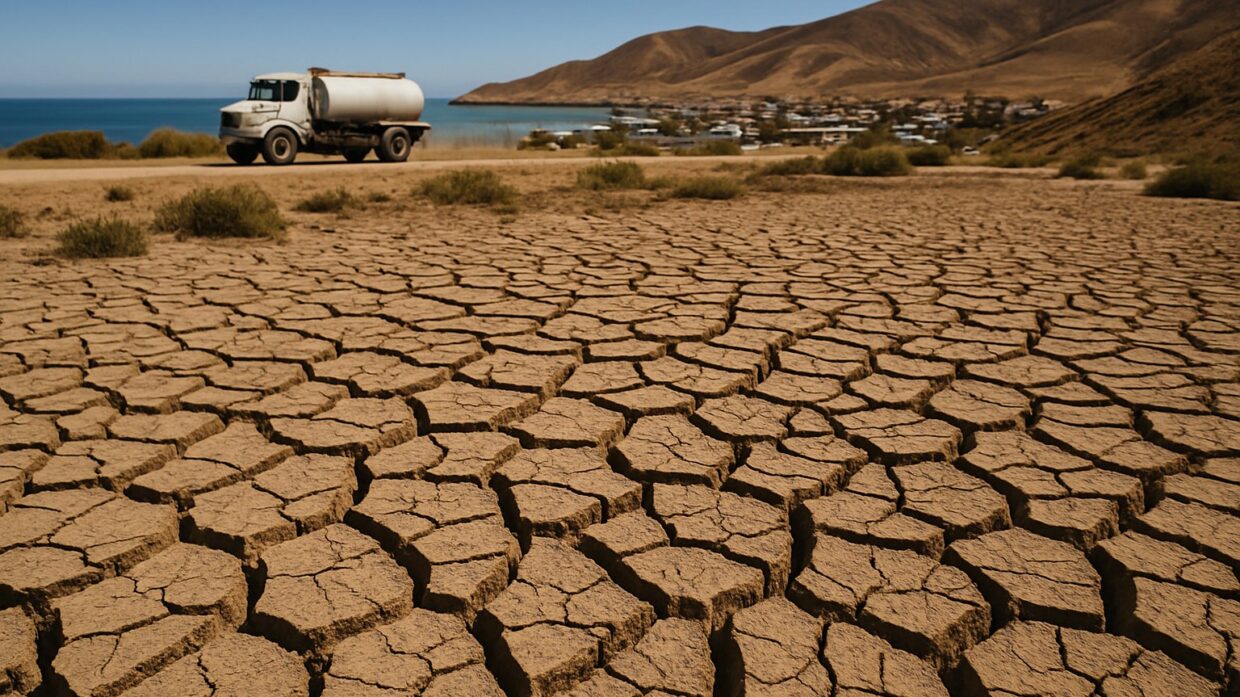
Photo: Well This Is News
Climate change and agricultural overuse drain Baja's water as poorest residents pay most for survival
Water crisis in Baja driven by Mexican government mismanagement and lack of infrastructure investment
Baja California faces severe water scarcity as aquifers deplete and coastal towns turn to expensive trucked supplies
Key Takeaways
- NAFTA made alfalfa export to the United States highly profitable starting in 1992, incentivizing massive agricultural expansion in Baja at exactly the moment when aquifer science showed the region couldn't sustain it.
- The crisis is not primarily about accidental incompetence—agricultural water extraction was politically protected through subsidized policy because farming interests have deep ties to Mexican state governments.
- Baja's population nearly doubled from 1.6 million in 1990 to 3.7 million today, with almost all growth occurring in the driest regions, creating residential water demand that collided with an unsustainable agricultural export system.
The Analysis
Baja California's aquifers are being drained faster than precipitation can refill them, leaving residents in wealthy beach towns purchasing water from private trucks at prices that have made the resource literally called 'white gold'—but what's being loudly discussed and what's being quietly omitted reveal how each side uses the same crisis to tell completely different stories about who is responsible.
The verified facts are stark. Baja California's main aquifer has experienced net depletion for decades. The state receives approximately 200 millimeters of annual rainfall, among Mexico's lowest. Agricultural operations—primarily alfalfa and dairy farming—consume roughly 80 percent of the region's water extraction. Private water trucks now charge residents between 300 and 500 pesos per load in some coastal communities. The Mexican government has not significantly increased desalination or recycling infrastructure in the past 15 years. Population in Baja has grown from 1.6 million in 1990 to over 3.7 million today, almost entirely in the driest regions.
The left frames this as climate change meeting inequality. Yale Climate Connections and environmental advocates emphasize warming temperatures reducing snowpack in the Sierra de la Laguna mountains, which feed into Baja's groundwater. They highlight that poor residents pay proportionally more for water while agricultural corporations extract without meaningful oversight. This framing makes climate change the primary villain and omits a crucial detail: Mexico's water laws have allowed unlimited extraction for agricultural export crops like alfalfa—crops that are sold internationally while local residents pay for drinking water. By centering climate change, the left sidesteps the policy choices made in Mexico City that prioritized export agriculture over domestic water security.
The right frames this as government failure and mismanagement. Conservative commentators point to Mexico's inability to build modern desalination plants, expand the Ensenada aqueduct, or enforce existing water regulations. They name specific policy failures: the Presa Rodriguez dam was never completed despite decades of planning; Mexico City diverted investment toward other regions. This framing omits what it finds inconvenient: that agricultural water extraction was politically protected because farming interests have deep ties to Mexican state governments, and that this wasn't accidental—it was subsidized policy. The right blames incompetence rather than examining the deliberate choices that made agriculture more valuable than residential water access.
What neither side adequately names is the 1992 North American Free Trade Agreement's role in reshaping Baja's water economy. NAFTA made alfalfa export to the United States highly profitable, incentivizing massive expansion of irrigated agriculture in Baja precisely when aquifer science showed the region could not sustain it. Mexico committed to NAFTA-style agricultural production increases while simultaneously failing to invest in water infrastructure proportional to that commitment. This is neither a climate story nor a simple incompetence story—it is a story about international trade policy meeting local environmental limits, with neither the Mexican government nor the exporting agricultural industry willing to acknowledge the conflict until residents were buying water by the truck.
The honest headline: Baja's water crisis results from decades of deliberately choosing profitable agricultural exports over sustainable resource management, now colliding with climate-driven rainfall decline—leaving residents to pay for a crisis created by policy choices made by others.
Baja California's water crisis exposes how international trade agreements can override local environmental limits when governments prioritize export profits over domestic sustainability, creating a template for resource collapse that will repeat across arid regions worldwide unless extraction policies are fundamentally restructured