Photo: Well This Is News
Trump sends third carrier to Middle East while claiming war is over, escalating Iran tensions
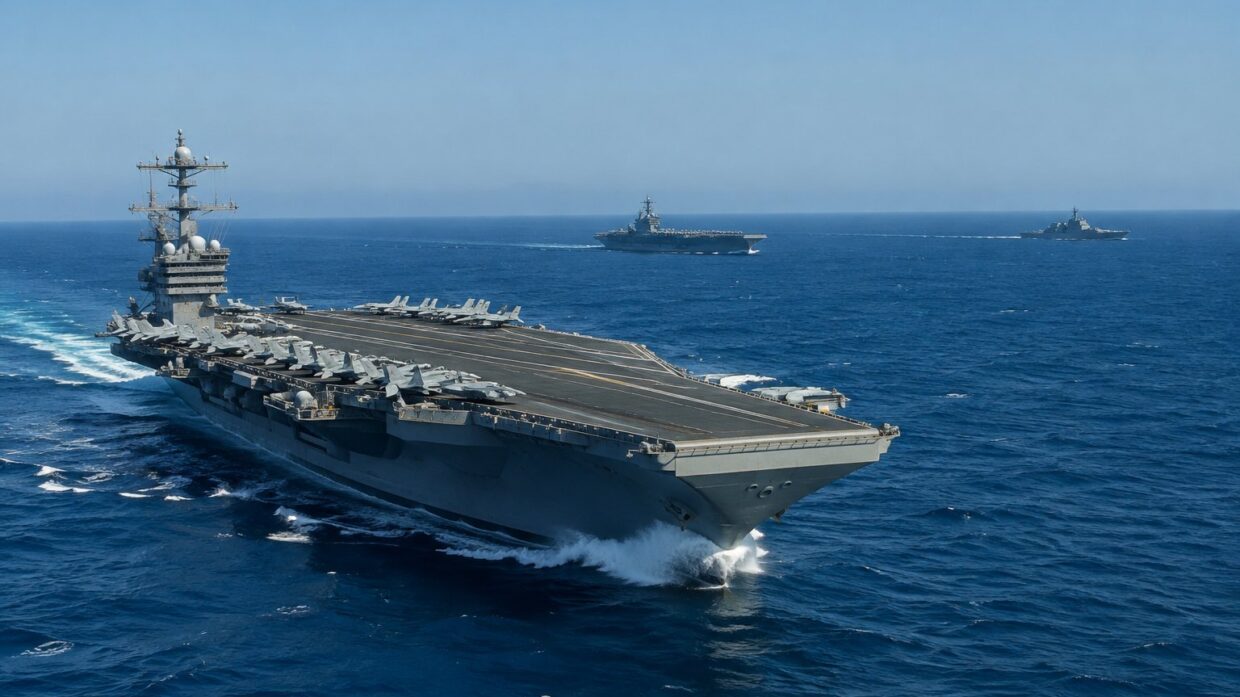
Third US aircraft carrier joins 50,000 troops in Middle East as Iran rejects nuclear inspections
We haven't found a neutral take on this story yet.
Breaking stories sometimes publish before every side has covered them. We'd rather show you that than invent a view.
The Analysis
The Trump administration has positioned a third US aircraft carrier in the Middle East, a deployment that the coverage frames entirely differently depending on which side is interpreting it. The carrier arrived as US Central Command confirmed Monday, bringing additional troops to a region already hosting over 50,000 American service members according to Breitbart's reporting. What the coverage splits on is not whether this happened, but what it signals about Trump's actual Iran strategy.
The Guardian frames the carrier deployment as a contradiction in Trump's messaging. The article emphasizes that the president oscillates between strike threats on Iran and insisting the war is militarily effectively over. This framing treats the deployment as evidence of an incoherent policy, one where military escalation contradicts the administration's public assessment of the conflict. The language choice matters: oscillates implies instability or deliberate confusion, not strategic ambiguity. The Guardian does not suggest why both statements might coexist as policy.
Breitbart and Fox News frame the deployment as Trump keeping military options open amid escalating tensions with Iran. Breitbart specifies the number of troops, 50,000 and counting, to emphasize sustained commitment rather than contradiction. Fox News pairs the carrier arrival with Iran's rejection of UN nuclear inspections, linking the military deployment to Iranian defiance. This framing suggests the carrier arrives in response to Iranian behavior, not as evidence of policy confusion. The sequence implies causation: Iran escalates, the US maintains readiness.
What neither framing fully captures is the specific sequence of events that produced this moment. The sources establish that a third carrier arrived and that Iran rejected UN inspections, but the coverage does not establish what triggered Iran's inspection rejection, what statements from Trump preceded it, or what military calculations informed the carrier deployment timeline. The Hill's reporting is least argumentative but similarly avoids explaining the causal chain.
The critical omission from both sides is what US military presence at this scale is actually calibrated to prevent or achieve. The Guardian implies the deployment reflects policy incoherence. Breitbart implies it reflects necessary resolve. Neither source explains whether three carriers represents an offensive posture, a defensive deterrent, or a holding pattern pending diplomatic developments. Neither clarifies what the stated Trump policy actually is beyond maintaining options.
The terminology each side chooses reveals the interpretive frame. The Guardian uses oscillates and dramatically, language that emphasizes contradiction. Breitbart uses keeps his options open, language that reframes the same actions as flexibility. Fox News pairs the carrier with Iran's nuclear inspection refusal, linking Trump's military readiness to Iranian behavior rather than to Trump's own stated positions. That pairing is factually accurate but serves a narrative function: it explains the deployment as response rather than initiative.
The unresolved question is whether the third carrier signals a shift toward military action, a signal to Iran to change course, or a placeholder while diplomatic channels remain open. The sources do not establish Trump's actual Iran policy, only that the administration is maintaining military capability while public rhetoric remains unaligned. That gap between military deployment and stated policy is what the coverage from all sides leaves underdeveloped.
This carrier deployment will constrain Trump's diplomatic options with Iran for months regardless of his stated intentions. Three carrier groups represent approximately 12,000 sailors and 300+ aircraft permanently positioned to enforce a blockade or launch strikes, requiring sustained logistics, maintenance rotations and command-and-control infrastructure that cannot be rapidly repositioned without signaling retreat. The mere presence creates escalatory pressure: Iranian military planners must assume offensive capability even if Trump intends deterrence, forcing Iran's military to maintain high alert status and limiting Tehran's room to make concessions without appearing to capitulate to American force. Maintaining this posture drains defense budgets on both sides, hardens Tehran's domestic political position against negotiators, and makes any US climb-down from military readiness look like a costly loss. The deployment doesn't just reflect current policy; it anchors whatever policy comes next.