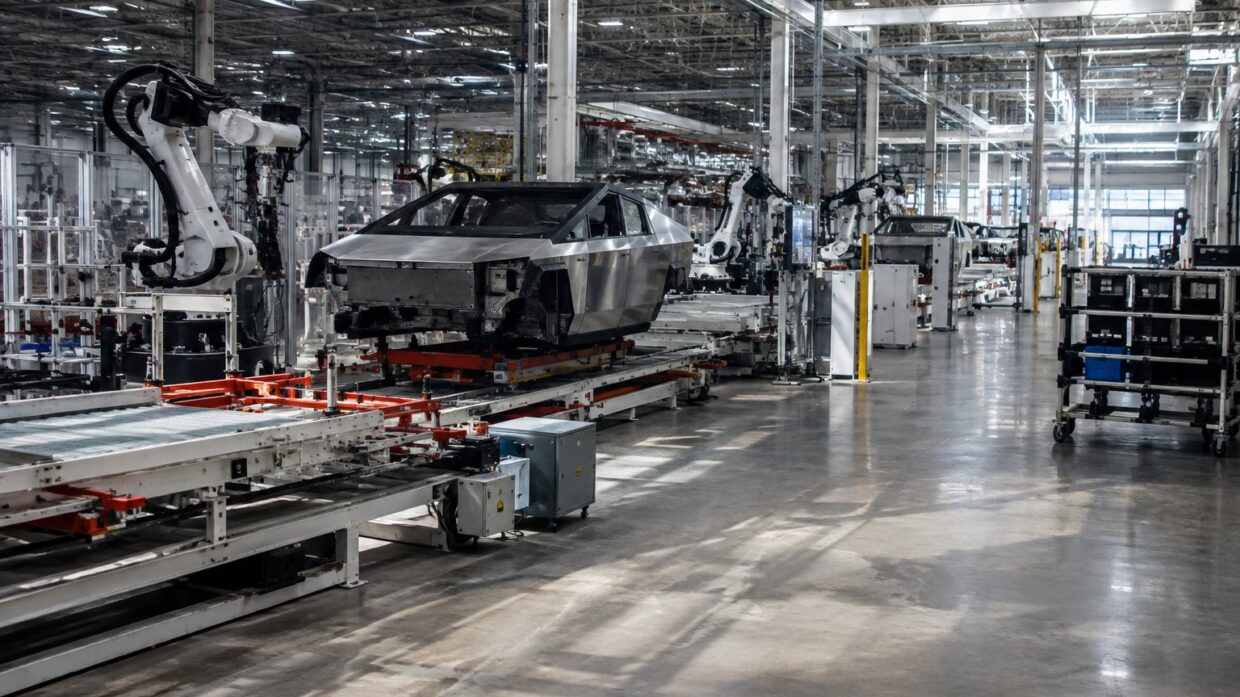
Photo: Well This Is News
Cybertruck, symbol of MAGA politics, dead after massive recalls and market failure
Tesla shifts Cybertruck production focus, moving to new models by 2027
Tesla to end Cybertruck production by mid-2027 after years of sluggish sales
Key Takeaways
- Tesla is planning a gradual production exit over 15-18 months rather than an immediate cancellation, suggesting the Cybertruck remains at least marginally profitable or that Musk wants to avoid sudden PR damage.
- The Austin Gigafactory, a $15 billion facility built specifically to produce Cybertrucks, will lose its primary product line by mid-2027 with no public announcement of what will replace it.
- Neither sales data nor recall severity details have been disclosed, leaving unresolved whether Cybertruck production is ending due to genuine market failure or strategic deprioritization of a still-functional product.
The Analysis
Elon Musk announced Friday on X that Tesla will wind down Cybertruck production by mid-2027, a decision that marks the end of one of the automotive industry's most closely watched new vehicle launches. What the reporting does not establish is whether this reflects strategic portfolio reallocation or a market rejection that Tesla is now compelled to manage.
The documented facts are straightforward. Tesla began Cybertruck deliveries in late 2023 and has faced production constraints, pricing pressure, and multiple recalls. Mother Jones cites "years of lagging sales and multiple high-profile recalls." MarketWatch attributes the decline to "high prices and some notable recalls." Breitbart's reporting is minimal on mechanics, focusing instead on the announcement itself. The public record does not specify which recalls, their severity, or whether they materially affected sales velocity or merely contributed to negative perception.
The left frame, represented by Mother Jones, emphasizes the political symbolism of the Cybertruck. The language used is "brutal" and "aggr," terms that connect the vehicle's design to MAGA aesthetics and positions the production end as a symbolic defeat. This framing leaves out the distinction between a product failure driven by market economics and one driven by political rejection. It also omits Tesla's actual sales figures and whether demand is genuinely insufficient or whether Musk's strategic priorities have simply shifted toward higher-margin or higher-volume products.
The right frame, represented by Breitbart, treats the production wind-down as a straightforward business decision. Breitbart's phrasing "plans to stop building" and "shift production" strips the announcement of moral weight and presents it as a neutral operational move. This framing leaves out any acknowledgment of recall patterns or sales weakness. It also does not address whether the Cybertruck is being discontinued because it is unsuccessful or merely deprioritized while remaining profitable at lower volumes. That distinction matters for readers evaluating Tesla's broader operational competence.
What neither side adequately addresses is the timeline. A production wind-down in mid-2027 is not an immediate cancellation. It suggests Tesla expects to continue selling Cybertrucks for at least 15-18 months from Musk's announcement. If demand were catastrophic, a faster exit would be rational. The extended timeline may indicate that the Cybertruck remains marginally profitable or that Tesla wants to avoid the PR cost of an abrupt kill. The reporting does not establish which.
Nor does either frame address the factory implications. The Cybertruck is produced at Tesla's Austin Gigafactory, a $15 billion facility that opened in 2023. If Cybertruck production ends mid-2027, what product fills that capacity? MarketWatch mentions only that the factory will "shift production" without specifying to what. This is a significant operational detail that shapes whether this decision represents a failure of that specific product or a rational reallocation of assets.
The more complete headline is this: Tesla is ending Cybertruck production in mid-2027 as sales underperformed relative to investor expectations, forcing Musk to either redirect Austin factory capacity or accept lower utilization. Whether this reflects a flawed product or sound portfolio management depends on data the public record has not disclosed.
Tesla's decision to wind down Cybertruck production by mid-2027 exposes a critical vulnerability in how automakers forecast demand for radically designed vehicles. The $15 billion Austin Gigafactory, built specifically to produce the Cybertruck at scale, will require retooling or face significant capacity underutilization starting in late 2026. This forces Tesla to publicly acknowledge that a vehicle marketed as revolutionary and strategically central to the company's future cannot sustain the production volumes that justified the factory's construction cost. The extended timeline suggests marginal profitability rather than catastrophic failure, but either outcome signals that Musk's ability to accurately predict consumer appetite for polarizing design has limits. Investors and competitors will now scrutinize whether other Tesla products rely on similarly optimistic demand projections.