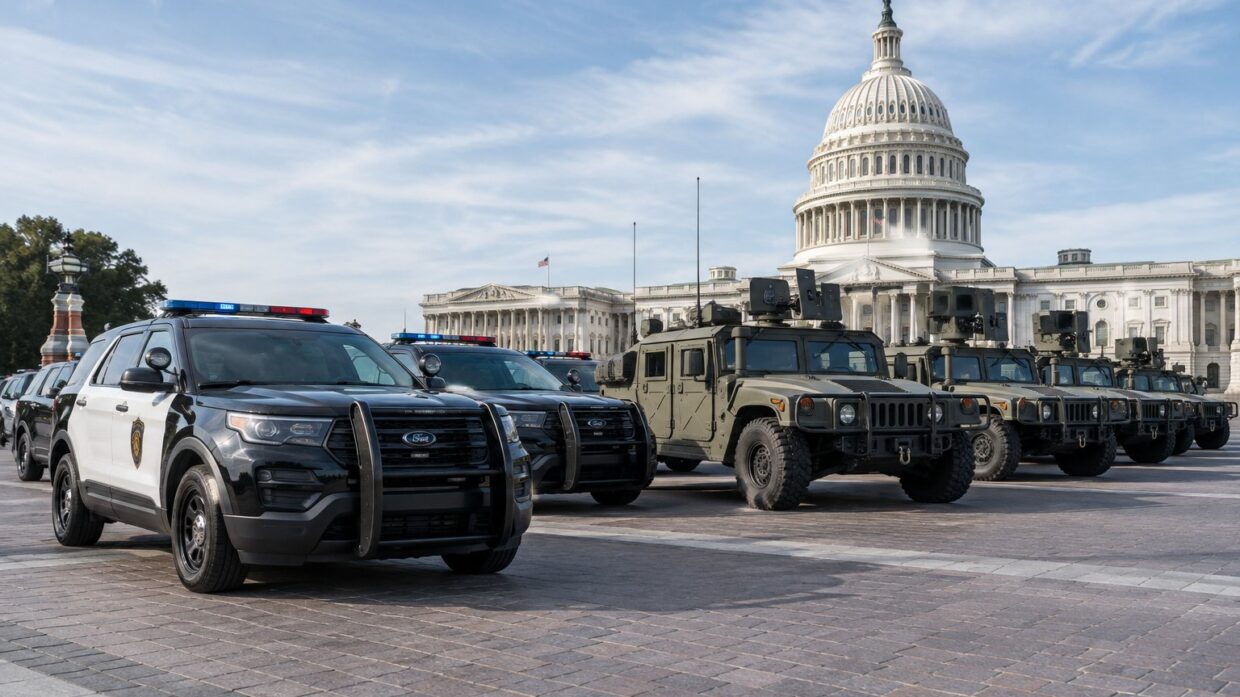
Photo: Well This Is News
We haven't found a left-leaning take on this story yet.
Breaking stories sometimes publish before every side has covered them. We'd rather show you that than invent a view.
Trump gives DC troops new muscle as Democrats plot National Guard exit
Hegseth authorizes National Guard to expand DC patrols with military vehicles and boats
Key Takeaways
- The National Guard was already deployed in Washington DC before Defense Secretary Hegseth's October authorization, which expanded the equipment available to existing troops rather than authorizing a new deployment.
- No reporting has documented what public safety outcomes the National Guard presence has actually achieved, making it impossible to determine whether the expansion scales an effective program or escalates military presence for political reasons.
- The DC Council's formal demand for National Guard removal lacks documented details about whether their concerns stem from public safety metrics, constitutional questions about federalizing local policing, or partisan objections.
The Analysis
Defense Secretary Pete Hegseth signed an October 29 authorization expanding National Guard operations in Washington, DC to include up to 60 marked police patrol cars, Humvees, military tactical vehicles, and National Guard boats. The specific assets approved represent a measurable increase in visible military presence in the nation's capital, though the authorization does not establish new operational boundaries or define the geographic scope of deployment.
The right-leaning framing emphasizes Trump administration strength and Democratic resistance. Fox News and The Daily Wire use language like "expands," "new muscle," and "deepens integration" to characterize the authorization as a necessary expansion of law enforcement capacity. The Daily Wire explicitly frames this as "Dems plot National Guard exit," positioning the approval as a direct response to Democratic council members' call for removal of out-of-state troops. This framing leaves out context about when the National Guard was initially deployed to DC, under what authority, and what specific public safety metrics justify the expansion.
Centrist sources including PBS NewsHour, The Hill, and Bloomberg describe the same facts but frame the development differently. They emphasize that Hegseth "allows," "has signed off on," or "is expanding" the presence, using more neutral verbs that neither celebrate nor condemn. They note that troops are "deepening integration with local law enforcement," which is descriptive but raises an implicit question about the scope of that integration. These outlets foreground the political conflict without taking a side on its merits.
What neither framing establishes is when the National Guard was first authorized to deploy in DC or under what original mandate. The National Guard presence in Washington predates the Trump administration's October authorization. The authorization Hegseth signed appears to expand the tools available to existing troops rather than authorize an entirely new deployment. The reporting does not clarify whether the boats, additional patrol cars, and tactical vehicles represent troops that were already stationed in DC gaining new equipment, or whether they represent an increase in total troop numbers.
The DC Council's demand for National Guard removal is documented in the reporting, but the specific grounds for that demand are not spelled out in these articles. The council members' stated concerns may relate to federalizing local law enforcement, concerns about accountability, or questions about the original deployment authorization. The available coverage does not establish whether the council's request was based on public safety metrics, constitutional concerns, or partisan opposition.
The significant omission across all reporting is the absence of data on what public safety outcomes the National Guard presence has achieved. None of the articles cite crime statistics, arrest numbers, or measurable changes in DC safety since the deployment began. This absence means readers cannot assess whether the expansion represents evidence-based scaling of an effective program or escalation justified by political rather than operational reasoning. The record also does not establish who requested the boats, or whether that asset represents a specific operational need or general expansion of military capabilities in the capital.
This authorization matters because it establishes operational precedent for permanent military assets in civilian law enforcement operations without triggering the transparency mechanisms that would normally accompany such a shift. The absence of defined geographic scope, measurable public safety outcomes, or clarity on original deployment authority creates institutional ambiguity about what triggers removal versus expansion of military presence in the capital. Future administrations now inherit a normalized framework where Defense Secretary approval alone can expand military hardware in DC without congressional authorization, oversight hearings, or the crime data that would justify such escalation. The boats, vehicles, and tactical equipment lack documented operational necessity, meaning this authorization bypasses the institutional guardrails that typically constrain militarization of civilian spaces. Whether this deployment succeeds or fails, its expansion sets a structural precedent that decouples military presence from measurable need.