Photo: Well This Is News
Democrats invest in judicial races ahead of 2026 midterms to counter conservative court dominance
Nine battleground states will decide control of Congress in 2026 as Republicans defend majorities
We haven't found a neutral take on this story yet.
Breaking stories sometimes publish before every side has covered them. We'd rather show you that than invent a view.
The Analysis
The 2026 midterm landscape is fragmenting into two distinct electoral narratives, each emphasizing different contests and stakes, with critical omissions from both sides about why these battles matter simultaneously.
What actually happened: Democrats have begun funding state supreme court races in battleground states, according to Politico, with national groups viewing judicial control as crucial before 2026. Fox News identifies nine specific states, Texas, Ohio, Michigan, Wisconsin, Georgia, Iowa, Nevada, Maine, and Florida, as the decisive terrain for Congress, where Republicans defend existing majorities and Democrats pursue Senate pickups. Neither article discloses the total spending committed, the specific court vacancies being targeted, or which states appear in both the judicial and congressional strategies.
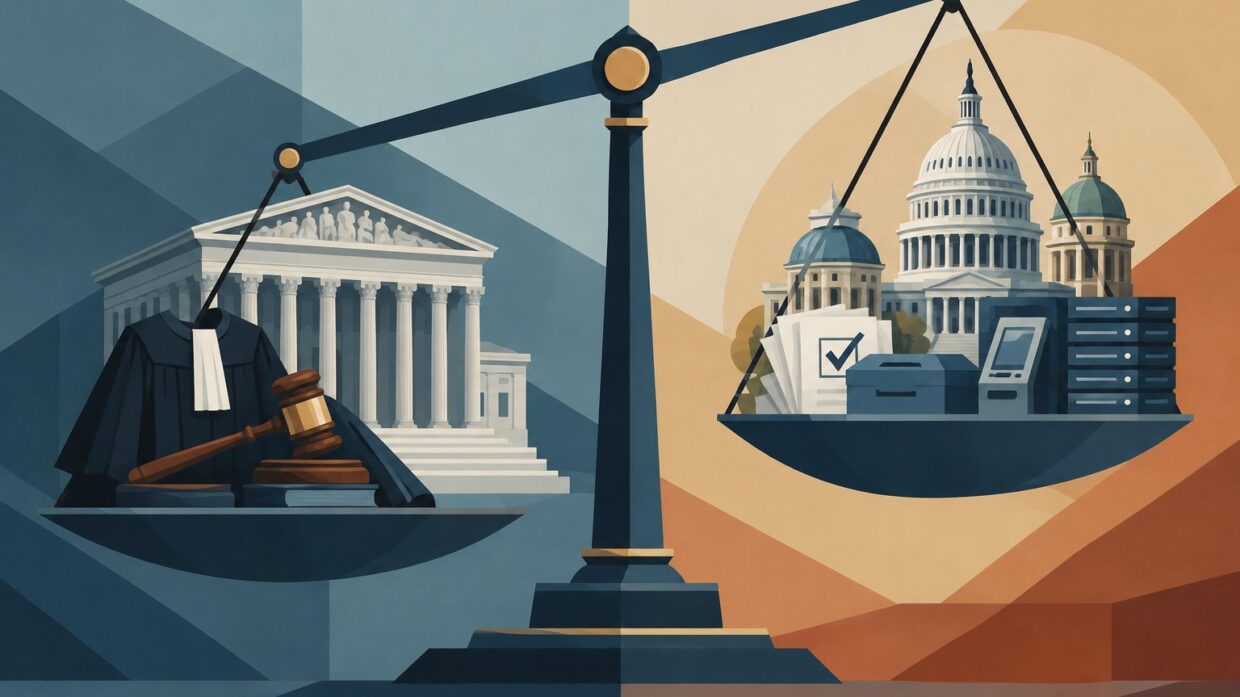
The left frame emphasizes state judiciary as the overlooked battleground. Politico reports that Democrats are directing resources toward supreme court races with the explicit goal of achieving liberal majorities in two years. This framing treats state courts as coequal with federal elections in strategic importance. The language focuses on what judicial control could protect: abortion access, voting procedures, environmental regulation. What this frame leaves out is whether Democratic judicial victories in 2026 would actually reverse existing conservative court majorities or merely prevent further conservative consolidation. It also does not establish whether the states targeted for judicial investment overlap with the congressional battlegrounds or whether Democrats are effectively spreading resources across two parallel elections.
The right frame emphasizes congressional control as the central 2026 story. Fox News presents nine specific states as the decisive terrain and frames the narrative around Republicans defending majorities and Democrats attempting to flip seats. This framing is more granular about geography but leaves out the state-level context entirely. It does not address why Republicans face a challenging environment in these nine states specifically, what demographic or political shifts have made them competitive, or whether local conditions differ significantly state to state. The framing also sidesteps any reference to state judicial races or what those outcomes might mean for federal policy implementation.
What neither side establishes is the relationship between these contests. A complete picture requires knowing: Are the same states critical for both congressional and judicial control? Are Democratic resources being concentrated or dispersed? What happens if Democrats flip a Senate seat in a state where Republicans maintain the state supreme court? The reporting does not clarify whether these are complementary strategies or competing priorities. Neither outlet explains that state courts control decisions on voting rules, redistricting challenges, and abortion regulation in the interim between elections, making 2026 judicial outcomes potentially more consequential than 2026 congressional outcomes for certain policy domains. The Fox piece assumes Congress is the meaningful power center; the Politico piece assumes courts are. The available reporting does not establish whether that choice is accurate or strategic framing.
The real headline is that Democrats are racing to compete in two simultaneous elections in 2026 without clarity about whether national groups have the resources, talent, or strategy to run competitive campaigns across both battlegrounds simultaneously. Republicans face the opposite problem: defending Congress in nine states while potentially being blindsided by judicial races they have not yet treated as strategically equivalent. The midterm story is not about which side will win in 2026. It is about whether the party structure and campaign apparatus in each state can handle two distinct, simultaneous electoral battles or whether one will necessarily starve the other.
State supreme courts control abortion access, voting rules, and redistricting challenges between federal elections, yet Democrats are dispersing resources across concurrent judicial and congressional races in identical battleground states without public disclosure of spending allocations or overlap strategy. If Democrats win a Senate seat in Michigan while losing the state supreme court, federal policy gains evaporate at the state level for years. Republicans have not yet mobilized judicial defense with congressional urgency in the nine targeted states, creating asymmetric vulnerability. The 2026 outcome will reveal whether modern party infrastructure can sustain two simultaneous high-stakes campaigns or whether state-level organization will collapse under divided attention, fundamentally reshaping which party controls implementation of federal law in swing states through 2032.