Photo: Well This Is News
Man charged with mailing white powder threats to members of Congress
Illinois man accused of mailing white substances to Congress in letters bearing his return address, claimed it was a joke
Illinois man charged with mailing threatening letters containing white substance to Congress members
Key Takeaways
- Federal law prosecutes threatening communications based on how a reasonable recipient would interpret them, not on the sender's stated intent, meaning Ungelsbee's claim that it was a joke does not automatically shield him from conviction.
- Capitol Police and the FBI are legally required to treat every white powder letter as a potential biological weapon until laboratory testing proves otherwise, making the substance's actual identity irrelevant to the initial threat response.
- The public record does not explain why Ungelsbee chose to include his own return address when mailing threatening letters, a factual gap that bears on whether this reflects recklessness, confidence in a misunderstood joke, or something else entirely.
The Analysis
Matthew Ungelsbee's indictment for mailing threatening letters containing white powder to members of Congress presents a case where the factual record and the defendant's stated intent diverge sharply, and each side has emphasized the elements that serve its framing while downplaying the rest.
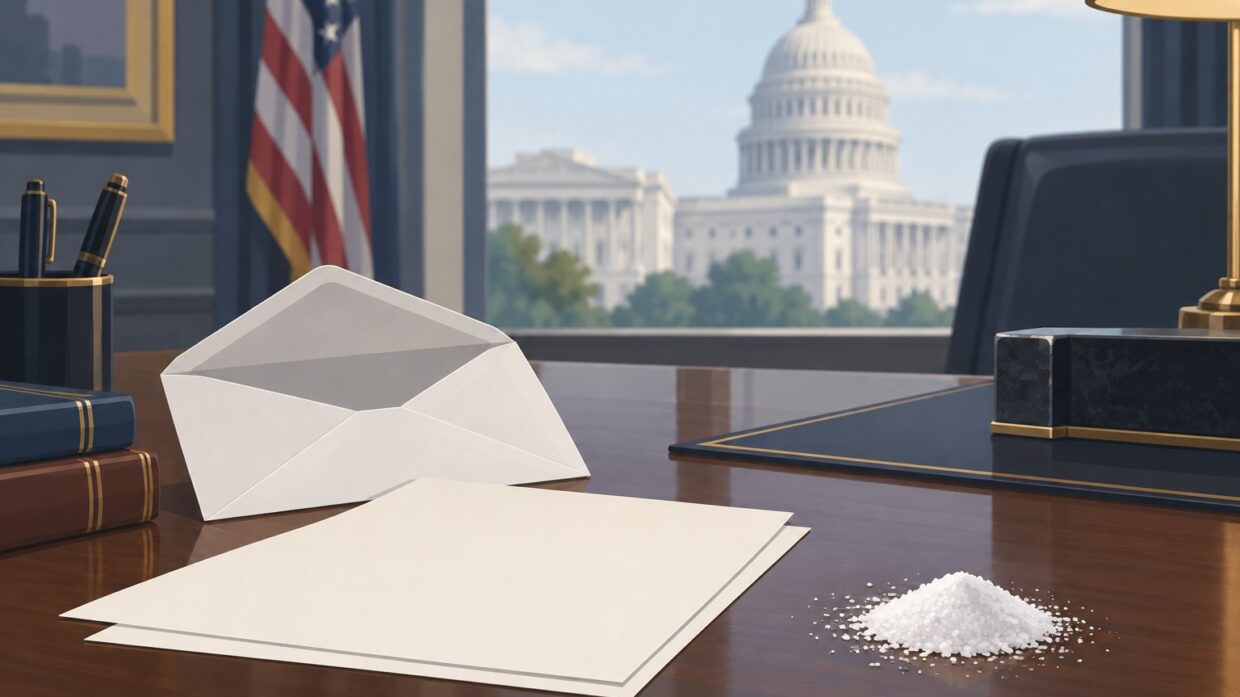
What the charging documents establish: Ungelsbee, 37, mailed four letters to Congress members. The envelopes bore his own name and home address. The letters contained a white granular substance. One letter included the text "HAH enjoy the gift." The substance was tested. Ungelsbee was interviewed by the FBI and told investigators the powder was salt and that he intended the mailings as a joke. He has been charged under federal law for threatening Congress members.
The left-aligned framing, represented by HuffPost and NBC News, emphasizes the threatening language, the specific quote "HAH enjoy the gift," and the fact of the white substance itself. This framing treats the case as a straightforward threat against federal officials requiring prosecution. The word "threatening" appears in the lead sentence and headline. The substance is called "white powder" rather than identifying it as salt. The emphasis falls on the seriousness of the act and the necessity of the federal response. What this framing leaves out is Ungelsbee's explicit statement to the FBI that he meant it as a joke and that the substance was salt, not an unknown or dangerous material.
The right-aligned framing, represented by Fox News, foregrounds Ungelsbee's claim that the substance was salt and his statement that the mailings were intended as a joke. This framing raises the implicit question of whether a prank with a return address attached constitutes a criminal threat or something less serious. By naming his own address on the envelope, the defendant's actions are presented as inconsistent with genuine intent to harm or terrorize. Fox emphasizes the defendant's characterization over the threatening language in the letters themselves. What this framing does not address is why threatening language appears in letters sent to federal officials, regardless of intent, and what legal and safety protocols require treating such mailings as threats until proven otherwise.
What neither side directly addresses is the gap between intent and consequence in threat cases. Federal law on threatening communications does not require proof that the sender intended genuine harm. It requires proof that the communication would reasonably be interpreted as a threat by the recipient. Capitol Police and the FBI must treat every white powder letter as a potential biological threat until testing confirms otherwise. The defendant's return address does not resolve whether reasonable recipients would interpret "HAH enjoy the gift" in a letter containing white powder as threatening, which is the legal standard.
The public record also does not establish why Ungelsbee chose this form of communication, why he included his own address, or whether he understood the legal consequences of his actions. These gaps make it difficult to assess whether this reflects genuine intent to threaten, genuine belief that the joke would be understood as harmless, or some combination neither side is fully articulating.
The underlying question is whether the case represents a criminal threat to Congress members requiring prosecution or a misguided prank that crossed legal lines through recklessness rather than intent to harm. The charging decision suggests federal prosecutors assessed the evidence as establishing the former. That assessment may be correct, but it rests on legal standards about threat communications that neither news framing explicitly explains to readers.
Federal threat laws don't require proof of intent to harm, only that reasonable recipients would interpret a communication as threatening. By mailing letters containing white powder with the text "HAH enjoy the gift" to Congress members, Ungelsbee triggered protocols that Capitol Police and the FBI must follow for every suspicious powder letter, regardless of his claim that it was salt and a joke. This case will influence how federal prosecutors handle the boundary between reckless pranks and prosecutable threats against government officials, potentially expanding or narrowing the circumstances under which crude jokes sent through the mail to federal targets result in felony charges. The precedent affects how broadly "reasonable recipient" standards apply to mailings that create genuine security burdens and investigation costs.