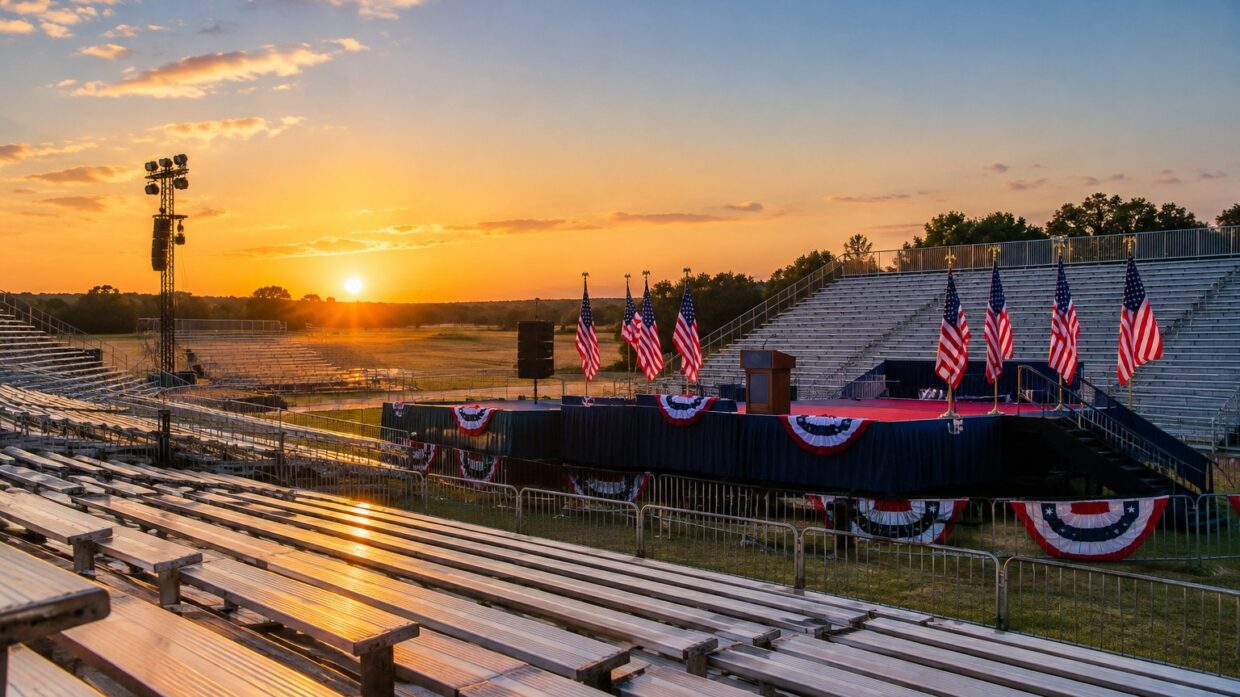
Photo: Well This Is News
Trump campaigns in Mississippi, highlighting Republicans' electoral vulnerabilities
Trump touts immigration enforcement at Mississippi rally with criminal arrest data
Trump rallies in Mississippi during midterm closing campaign stretch
Key Takeaways
- Mississippi is a heavily Republican state in recent electoral cycles, yet neither news coverage explains whether internal polling indicated the state was actually competitive.
- Campaign schedules for rally stops are typically planned weeks in advance, but reporting does not clarify whether Trump's Mississippi visit was strategically urgent or routine scheduling.
- Both left and right framing rely on interpretations of what the rally symbolizes rather than on disclosed data about the campaign's actual strategic assessment of the state.
The Analysis
Trump's Mississippi campaign stop eight days before the midterm election reveals a fundamental disagreement between left and right coverage about what the rally was actually demonstrating and what it means for the parties' electoral position.
The verifiable facts are straightforward: Trump campaigned in Mississippi on Monday as part of a campaign rally schedule in the closing weeks before the November midterm election. This visit occurred within a broader pattern of Trump appearing at multiple rallies during the midterm cycle. Immigration enforcement records from ICE operations in Mississippi showed arrests of individuals with prior convictions, according to the reporting.
The left's framing, represented by HuffPost and NPR, emphasizes that the rally was a symptom of Republican electoral "challenges" or "vulnerabilities." The language choice matters. HuffPost's headline explicitly states "Republicans' Challenges." NPR uses similar framing: "highlighting Republicans' challenges ahead of an election that could drastically shift power in Washington." This language implies Trump's presence in a state is evidence of GOP weakness, not strength. The unstated logic is that candidates appear in competitive races, not safe ones. The coverage leaves out what it does not establish: whether Mississippi was actually competitive, whether Trump's appearance was responsive to polling data suggesting a specific threat, or whether the rally was primarily a turnout mobilization event. That omission is significant because it transforms a campaign activity into proof of distress without establishing the premise.
The right's framing, represented by The Daily Wire, leads with what Trump was "touting," placing the emphasis on a specific policy message. The headline mentions "A List of Criminals Caught in Immigration Raids," directing attention to enforcement data and criminal records. This framing positions the rally as a platform for communicating an accomplishment and a campaign contrast. The Daily Wire foregrounds arrests with "murder and sexual assault convictions," making a direct appeal to enforcement credibility. The coverage leaves out broader ICE operation statistics, apprehension numbers relative to prior years, or immigration policy outcomes that might contextualize these specific arrests. That omission shapes the reader's understanding by highlighting the most severe individual cases rather than systemic results.
What neither side fully addresses is why Trump was campaigning in Mississippi specifically in the closing week. Mississippi has been a heavily Republican state in recent cycles. The available reporting does not establish whether internal polling or strategic calculation indicated the state was competitive, whether the stop was part of a designed turnout surge, or whether it was a campaign rally scheduled well in advance. Neither source provides scheduling context or explains the campaign's rationale for the venue selection. That missing information would help readers understand whether the rally reflected electoral urgency (left's implication) or routine campaign activity (right's implication).
The deeper pattern neither side emphasizes is that both the "vulnerability" claim and the "accomplishment" claim rest on framing device rather than underlying data about the state's actual electoral position. One complete reading requires asking: Was Mississippi competitive? By what margin? What did internal Republican polling show? The coverage offers neither the left's implicit answer nor the right's implicit answer to that question, leaving readers unable to assess which interpretation aligns with the actual tactical situation.
Trump's Mississippi rally eight days before the midterms has become a test case for competing narratives about Republican electoral strength, but neither the left's "vulnerability" framing nor the right's "accomplishment" framing addresses the fundamental question their interpretations require: whether Mississippi was actually competitive. HuffPost and NPR imply weakness by suggesting a candidate appears in threatened races, yet provide no polling data showing the state was in play. The Daily Wire emphasizes ICE arrest records to tout enforcement success while omitting the campaign scheduling context that would explain why this stop mattered tactically. Both interpretations collapse without establishing Mississippi's baseline electoral position. Readers cannot distinguish between routine campaign activity and strategic response to internal polling, which means both sides have substituted narrative convenience for the verifiable data required to assess whether Trump's presence signaled distress or represented standard midterm mobilization.