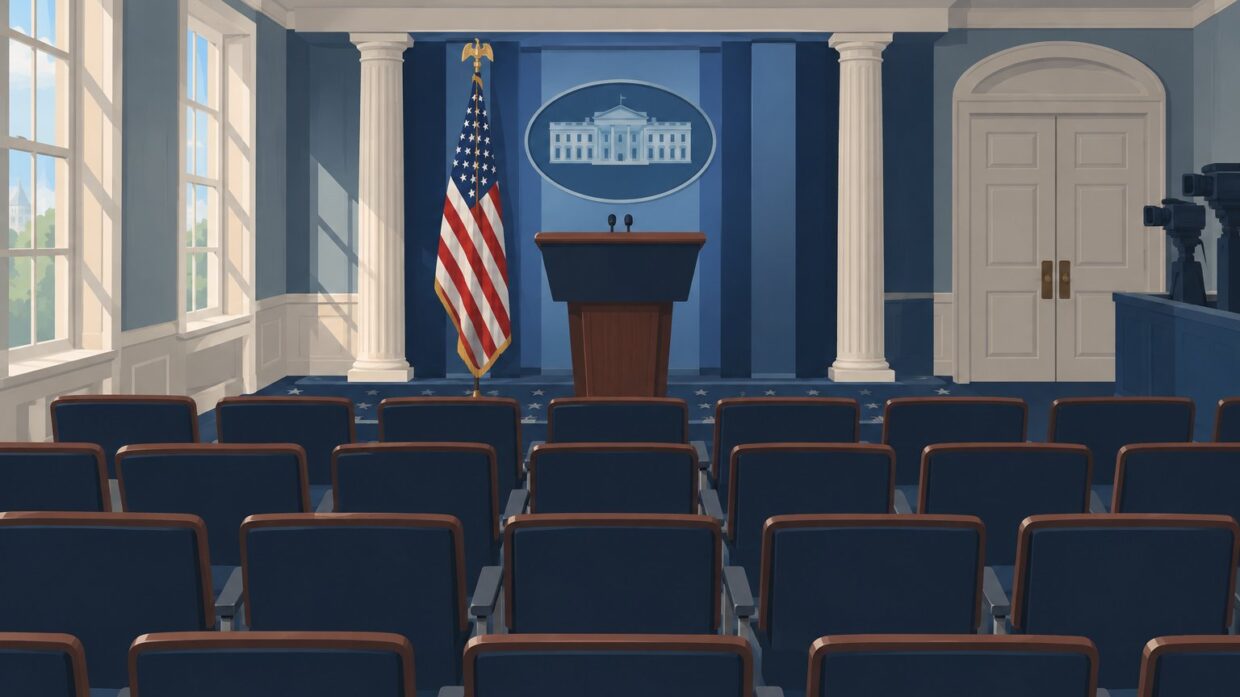
Photo: Well This Is News
Pete Souza's damning Obama comparison exposes Trump's assault on press freedom
White House emphasizes border security failures ahead of Trump rally in Florida
Trump White House restricts press access while critics invoke Obama-era comparisons
Key Takeaways
- The Trump White House is considering relocating the press corps from its traditional briefing room location, but relocation changes symbolism and logistics rather than the fundamental ability to report on the administration.
- Pete Souza's social media comparisons have generated significant media coverage despite being posts from a private citizen, raising questions about how much amplification they receive relative to their original impact.
- The Trump campaign's emphasis on a specific immigration-related crime case at a rally does not establish whether Biden policies directly caused the outcome or whether the case was selected primarily for political messaging impact.
The Analysis
Three separate stories about the Trump White House converge on a single tension: how an administration communicates its record while managing institutional relationships and critical comparison. What none of the framing explicitly addresses is what each side's choice of language reveals about which audiences they are trying to reach and which facts they prefer to emphasize.
The documented record establishes that the Trump administration is considering relocating the White House press corps from the briefing room, according to NPR's reporting on New York Times sourcing. Pete Souza, who served as Obama's official photographer from 2009 to 2017, has posted social media comparisons using archival images, though the specific content and exact nature of his "NONE-too-subtle" framing varies by account. The Trump campaign has amplified a case involving a Haitian national and a Florida woman's death, connecting it to border enforcement policies from the previous administration. These are three separate actions: one administrative, one communicative, one political.
The left frame emphasizes what Souza's comparison conveys about institutional degradation and norm-breaking. The HuffPost headline uses "trolls" and "damning," language that positions Souza's image selection as aggressive pushback against Trump rather than neutral documentation. This framing leaves out the specific details of what Souza's images actually show, which would allow readers to evaluate the comparison independently. It also does not explain why a private citizen's social media posts merit White House-level coverage, a question that matters to understanding the actual power dynamics at play. The left's emphasis on press freedom concerns is genuine, but it does not address how the press itself has incentivized controversy through amplification, or whether relocation itself changes reporting capability versus merely changing symbolism.
The right frame emphasizes immigration enforcement and public safety consequences. The Fox News framing names a specific victim, a specific allegation against Biden policies, and a specific campaign event. This grounds the story in material harm that voters can evaluate. What this framing underplays is the baseline data on immigration-related crimes under different administrations, the specific legal status of the individual cited, and whether the Biden administration's policies directly caused this outcome or whether other factors intervened. It also does not address whether highlighting this case at a Florida rally, rather than in a policy briefing, signals something about the intended audience and the rhetorical work the story is meant to perform.
What neither framing captures is how institutional practice diverges from institutional norms. A White House has the power to relocate the press corps; whether it should is a separate question. A photographer can make comparisons; whether those comparisons constitute legitimate accountability or performative criticism depends on specificity. An administration can emphasize border policy failures; whether those failures are the relevant policy question or whether the emphasis serves a different political purpose is not answered by citing one case. The underlying question is whether each action represents substantive policy disagreement or a competition over which administration's legitimacy the public will accept. The record does not yet establish which.
A White House press relocation would accomplish what neither formal restrictions nor access denials can: it erases the visual and spatial reminder that accountability infrastructure exists at all. Once the briefing room empties, future administrations face no architectural pressure to maintain the practice of regular questioning. The physical space becomes a constituency. Souza's comparisons matter less as social media performance than as documentation that someone with institutional credibility still recognizes when democratic practice degrades. The immigration case matters less as isolated tragedy than as test of whether voters accept retroactive policy vindication through anecdote. What determines whether press access restrictions stick as precedent is not which side argues louder but whether the next administration inherits the normalized absence as its starting point.