Photo: Well This Is News
We haven't found a left-leaning take on this story yet.
Breaking stories sometimes publish before every side has covered them. We'd rather show you that than invent a view.
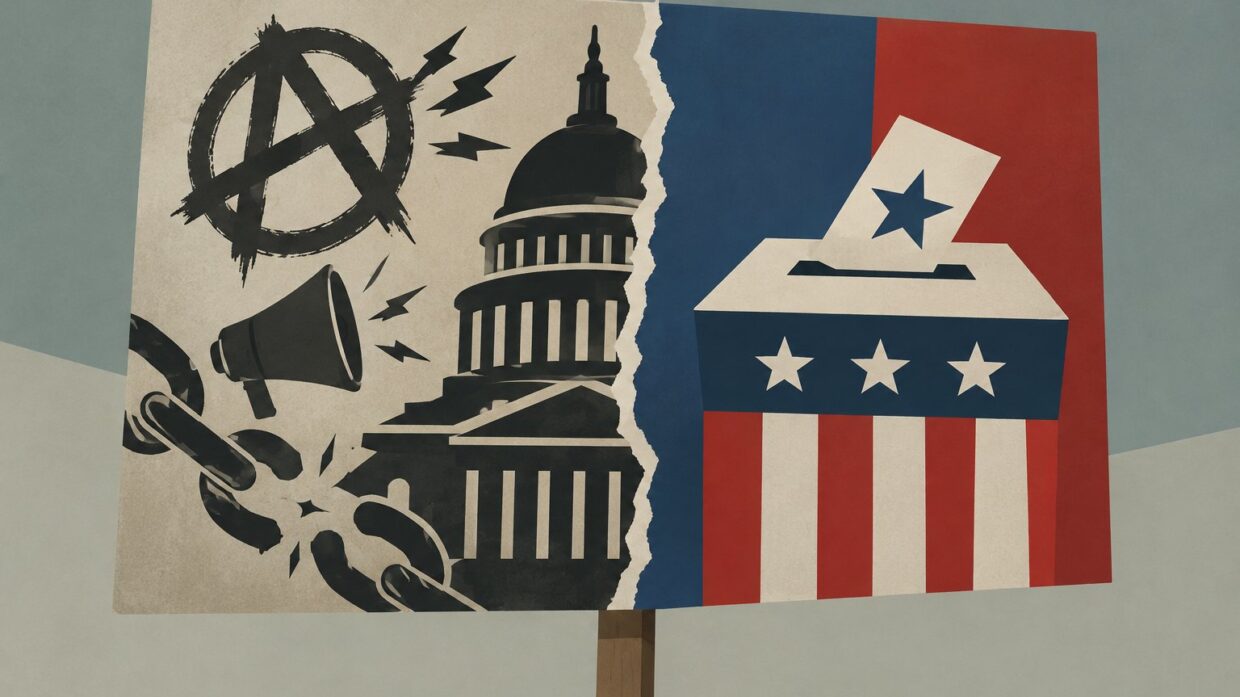
No Kings organizers push vote-blue messaging that contradicts their own nonpartisan rules
We haven't found a neutral take on this story yet.
Breaking stories sometimes publish before every side has covered them. We'd rather show you that than invent a view.
The Analysis
The No Kings coalition established itself around a stated commitment to anti-establishment politics across ideological lines, with organizers publishing explicit rules prohibiting partisan voter directives and party-affiliated slogans at rallies. The reported contradiction between the coalition's published guidelines and actual messaging at events raises a specific question about enforcement and intent that neither the available reporting nor the coalition's public statements fully resolves.
Fox News reporting documents that protesters at official No Kings events used language directing voters to "vote blue" and elect Democrats, directly contradicting the coalition's rulebook. The framing emphasizes this as hypocrisy: organizers established nonpartisan standards but then either failed to enforce them or did not enforce them uniformly. The reporting uses direct quotes from both the published guidelines and the observed messaging, establishing a factual gap between stated policy and reported practice. This framing leaves out context about whether organizers issued warnings before the rallies, whether local organizers or national leadership made different choices, or what specific enforcement mechanisms existed.
The right-leaning interpretation of this story centers on institutional credibility: if an organization publishes nonpartisan rules and then allows partisan messaging, that constitutes either dishonesty or loss of control over member groups. Fox News' language choice of "foot soldiers ignore organizers' warning" attributes agency to protesters while suggesting organizers attempted to maintain standards. The framing suggests that the gap between stated principles and observed behavior reveals something about the actual partisan nature of the movement, regardless of its public positioning. This reading does not address whether the violation was widespread, systematic, or limited to specific locations or whether coalition leadership disagreed with the observed messaging.
What the available reporting does not establish is why the gap exists. The public record does not disclose whether national organizers chose not to enforce the rules, whether local organizers disagreed with the rules, whether specific branches of the coalition operated under different interpretations, or whether the rulebook itself was purely aspirational rather than binding. The reporting also does not confirm whether organizers actually issued warnings before Saturday's events, though one Fox News headline references such warnings. The scope of the problem remains unclear: reporting indicates some events included partisan messaging, but does not establish whether this occurred at most rallies, all rallies, or a subset.
A fuller picture requires understanding what the No Kings coalition is and what unified it. The available reporting references 300 groups but does not establish their ideological composition, membership overlap, or decision-making structure. It does not clarify whether the coalition functioned as a coordinated national organization with enforcement power or as a loose network of affiliated groups. That distinction matters because it changes the meaning of the conflict: if the coalition is tightly structured, a gap between rules and practice suggests institutional failure; if it is decentralized, it suggests disagreement about the coalition's purpose.
The most honest framing of this story is not that organizers deliberately pushed partisan messaging while pretending to be nonpartisan, but that an anti-establishment coalition structured around both left and right participants developed an internal conflict over whether its purpose was genuinely cross-partisan or primarily progressive. The rule-violation itself is documented. The motivation, structural origin, and prevalence of that violation remain unclear.
Coalitions built around shared opposition to established power structures fracture predictably once that opposition succeeds or gains institutional access. The No Kings conflict over partisan messaging exposes whether decentralized anti-establishment movements can enforce binding agreements across ideologically diverse membership or whether the centripetal force holding them together depends entirely on shared enemies. If local organizers openly defied national guidelines without consequence, the coalition either lacks actual structural authority over its 300 member groups or leadership deliberately abandoned nonpartisan commitments once rallies attracted measurable crowds. That distinction determines whether similar cross-partisan coalitions can function as genuine political vehicles or whether they inevitably collapse into their constituent partisan identities. The precedent here shapes how future movements attempt to bridge ideological divides or whether they stop trying.