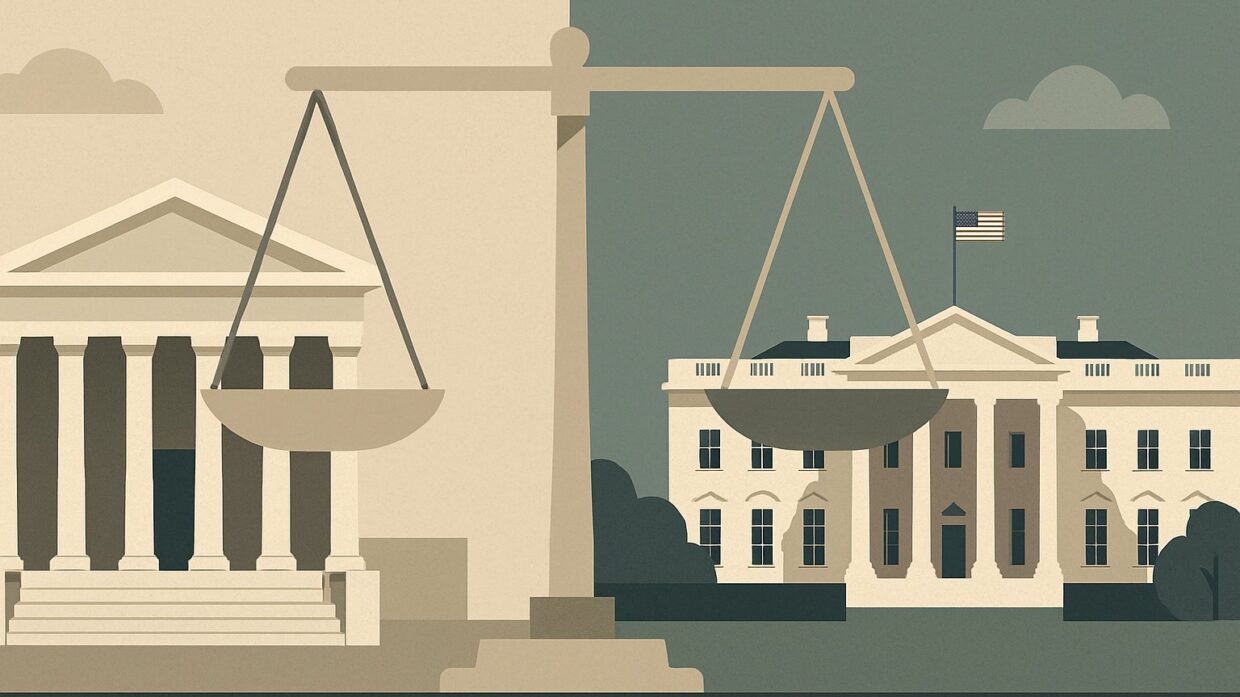
Photo: Well This Is News
Court records case shows stakes of judicial composition in presidential accountability
Vote Like Dems' Court-Packing Gambit Is On The Ballot Because It Is
We haven't found a neutral take on this story yet.
Breaking stories sometimes publish before every side has covered them. We'd rather show you that than invent a view.
The Analysis
A federal appeals court is reviewing whether documents created during a presidential administration belong to the sitting president personally or to the American people as custodians of the presidency. The case originates from a Trump administration argument that papers generated in the White House constitute personal property, not government records. NPR's reporting identifies this as a substantive legal dispute over the Presidential Records Act's scope. The Federalist frames the identical case as evidence of a Democratic scheme to reshape the judiciary, arguing that the outcome depends entirely on whether the Supreme Court has been packed with ideologically aligned justices.
What the left framing emphasizes is institutional accountability. NPR reports the case as a straightforward legal question: who owns presidential records? The coverage leaves implicit but does not foreground that the Trump administration's legal position would require the Supreme Court to narrow decades of interpretation about executive branch recordkeeping. The left's narrative arc moves from fact (the case exists) to institutional concern (who decides matters) to implication (judicial composition shapes outcomes). That framing leaves out any accounting of whether the Presidential Records Act's historical text actually supports the administration's reading, focusing instead on the higher-stakes question of whether courts will accept it.
The right framing flips the causal arrow entirely. The Federalist's headline and argument state that the case is significant not because of the legal merits but because it proves Democrats are strategically deploying court-expansion rhetoric to influence voting behavior. The right's language chooses "court-packing gambit" and "legitimate Supreme Court," framing the entire dispute as a partisan maneuver rather than a genuine legal conflict. That framing leaves out the specific language of the Presidential Records Act, the prior court decisions interpreting it, and any analysis of whether the administration's legal theory has doctrinal support. Instead it positions the case as evidence of a predetermined conclusion about judicial illegitimacy.
What neither framing addresses directly is the actual text of the Presidential Records Act or its legislative history. The law, enacted in 1978, defines presidential records as documentary materials created or received by a president in the conduct of official duties. Neither source quotes the statute. Neither source cites the specific appeals court's reasoning or the administration's legal memorandum. The left avoids this because it would require defending or distinguishing the government's reading of the statute. The right avoids it because the focus is not on law but on electoral narrative.
The underlying question both framings circle without naming is simpler: does the Presidential Records Act actually permit what the Trump administration claims? That question is separable from both "which party controls the courts" and "how should voters think about judicial composition." The legal merits remain underdeveloped in both accounts. One plausible interpretation is that the case will turn on whether "official duties" encompasses all White House activity or only narrowly construed governmental functions. Another is that the administration's theory would require the Supreme Court to overturn established practice without textual warrant. But the public record here does not establish which judicial philosophy would resolve the ambiguity as written.
What this actually signals is that major legal disputes now arrive pre-framed as institutional struggles. The case involves real disagreement about executive power. It will reach a court whose composition reflects real political choices. But the coverage from both sides skips past the legal reasoning entirely, treating the case as a proxy for a different argument: about whether courts are legitimate institutions or tools of partisan design.
Presidential records disputes will recur across administrations, and this case establishes whether sitting presidents can claim personal ownership of official documents or whether the Presidential Records Act creates an enforceable public trust in those materials. If the Supreme Court accepts the administration's position that documents generated during presidential work constitute private property, future presidents will operate under radically different constraints on document retention, destruction, and access, fundamentally altering the evidentiary record available to Congress, historians, and courts investigating executive conduct. The ruling will reshape what documentation the National Archives can compel and what immunity presidents enjoy from accountability mechanisms that depend on documentary evidence of their decision-making.