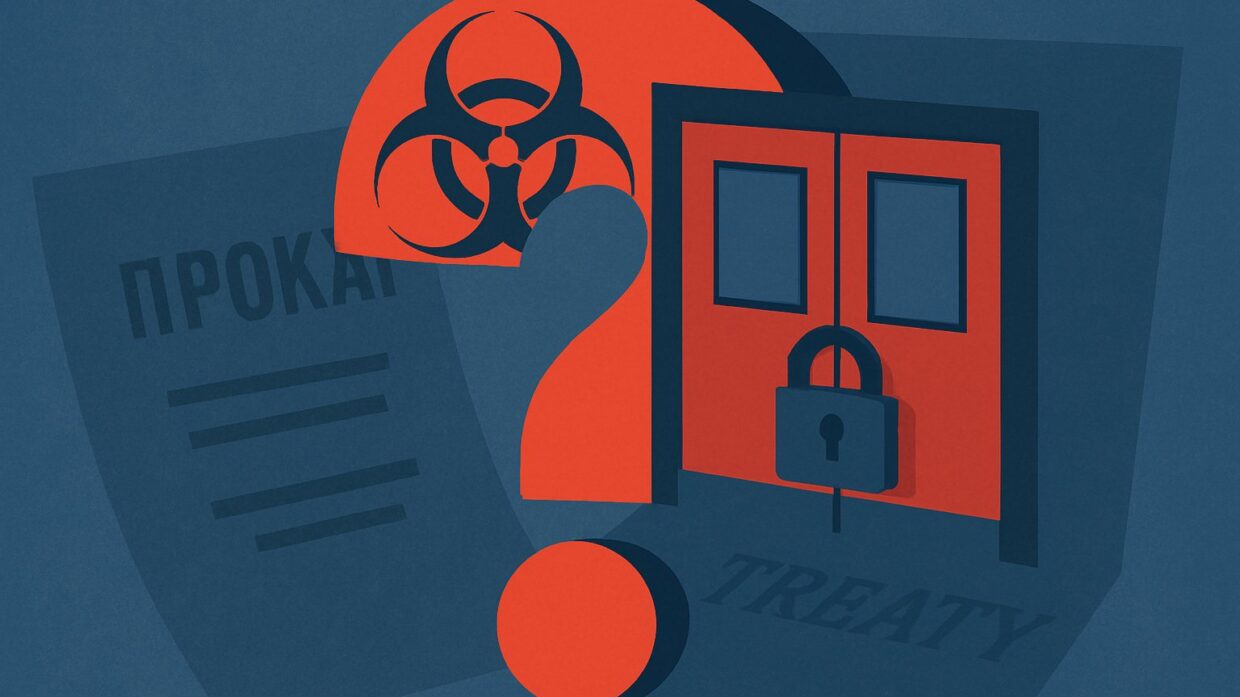
Photo: Well This Is News
Did Russia follow international rules on reporting suspicious lab death?
Russia's plague research death raises biosafety transparency concerns
Russia reports lab worker death; treaty compliance questions emerge
Key Takeaways
- The Biological Weapons Convention requires Russia to report deaths that could signal an outbreak, but the actual facts of what Russia reported, when it reported, and whether the death met reporting criteria remain publicly unknown.
- Skepticism about Russian compliance stems from documented historical evidence including alleged Soviet biological weapons programs and Russia's resistance to international inspections, not merely from geopolitical suspicion.
- A single death at a research facility does not automatically prove treaty violation without evidence showing Russia failed to meet its specific notification obligations in this instance.
The Analysis
Russia's reported death of a plague research employee at a laboratory facility has surfaced a specific compliance question: whether Moscow notified international bodies as required by the Biological Weapons Convention, a treaty signed by 197 nations including Russia that mandates reporting any death that could signal an emerging disease outbreak. The NPR reporting frames this as a direct test of Russian adherence to documented treaty obligations.
What actually occurred: A worker at a Russian plague research facility died. Russian officials attributed the death to pneumonia. The available reporting does not establish the precise timeline of when Russian authorities learned of the death, when or whether they notified relevant international bodies, or what the actual cause of death was determined to be through autopsy. The Biological Weapons Convention requires signatories to report deaths "that could be a sign of an outbreak to come," according to the treaty text cited by NPR, but the reporting does not disclose the specific diagnostic criteria used by Russian authorities to evaluate whether this death met that threshold.
The left frame, represented by NPR, emphasizes treaty obligation as the governing question. The language "did Russia play by the rules" assumes a clear rule exists and focuses on Russian compliance as a matter of institutional accountability. NPR's framing leaves out Russia's historical pattern of biosafety incidents and the institutional basis for skepticism about Russian transparency. It also does not establish what Russia actually reported, when, or to whom, focusing instead on whether reporting occurred at all.
The right frame, represented by National Review's brief reference to "Russia's peculiar plague scare," characterizes the incident as reflecting broader uncertainty about Russian research activities and biosafety. The language "peculiar" signals skepticism without establishing specifics. This framing leaves out the fact that a treaty exists, what it requires, or what evidence suggests Russia violated it. It treats the incident as evidence of a pattern rather than examining the specific facts of this case.
What neither side fully addresses: Russia and the United States have a documented history of disputes over the Biological Weapons Convention's verification and inspection protocols. The Soviet Union signed the original treaty in 1972 but later allegedly operated a large-scale biological weapons program, according to declassified U.S. intelligence assessments and the 1992 defection of Ken Alibek, a senior scientist from the Soviet program. Russia has subsequently resisted international inspections and challenge investigations under the treaty. A fuller picture requires acknowledging that skepticism about Russian compliance is rooted in specific historical evidence, not merely geopolitical tension. At the same time, a single death at a research facility does not automatically indicate treaty violation without evidence of what Russia reported and when.
The core unresolved question is not whether suspicion is warranted, but whether Russia met its specific treaty obligations in this instance. The available reporting does not establish what notification occurred, what diagnostic information was provided, or whether the death met the treaty's threshold for reporting. Without that factual foundation, the question of Russian compliance remains open.
Russia's resistance to international biological weapons inspections since the Cold War creates institutional grounds for skepticism about transparency at its plague research facilities, yet this case remains unresolved without establishing what Russia actually reported to international bodies, when notification occurred, and whether the worker's death met the Biological Weapons Convention's specific reporting threshold. The treaty's verification gap, which has persisted for decades without robust inspection mechanisms, means single incidents cannot confirm violations, but they expose the structural weakness that has allowed Russia to operate research programs with minimal external oversight. If Russia failed to notify relevant international bodies as required, it demonstrates the treaty's fundamental enforcement problem: signatory nations can violate obligations with limited consequences, undermining the entire verification framework that 197 nations ostensibly agreed to uphold.