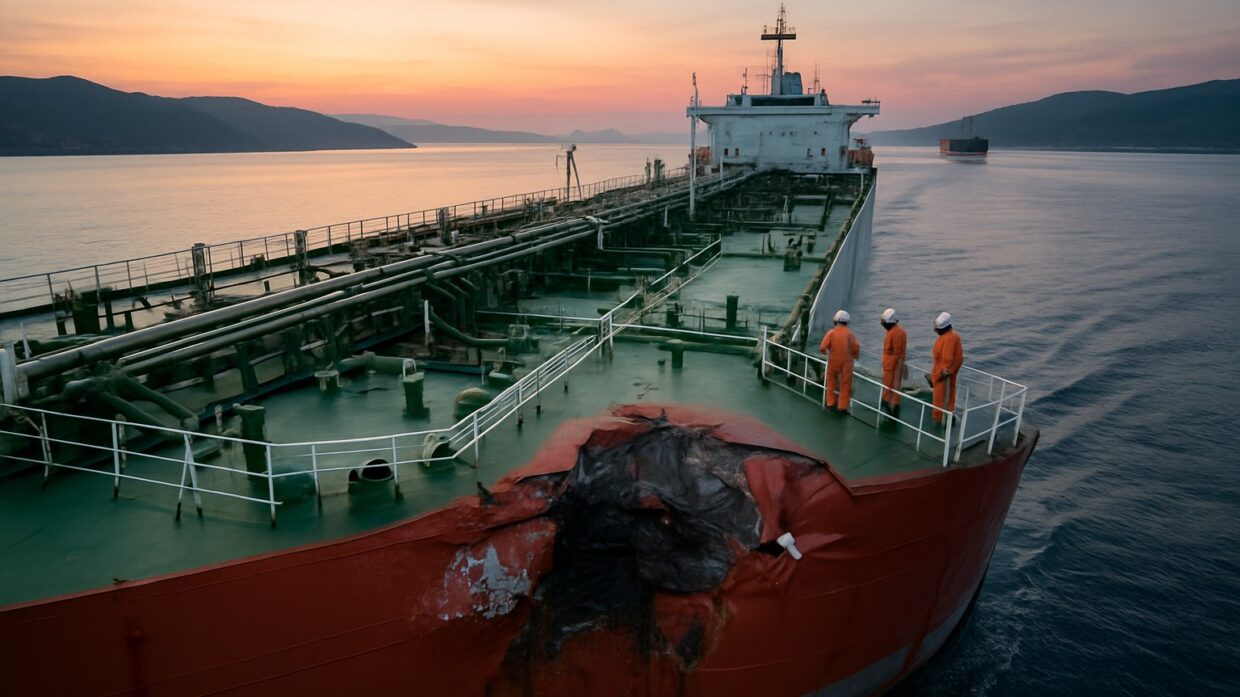
Photo: Well This Is News
U.S. Claims Victory at Hormuz, But the Strait Remains Contested
Oil Shipments Return to Normal Levels, Gas Prices Lag Far Behind
Oil Flows Resume Through Hormuz as Iran Escalates Tanker Attacks
Key Takeaways
- Iran has increased tanker attacks precisely as oil flows through Hormuz recover toward prewar levels, suggesting a deliberate strategy to keep shipping costs and insurance premiums elevated.
- Neither restored supply flows nor depleted U.S. inventories fully explain why gas prices remain high; Iranian disruption threats maintain a risk premium embedded in fuel costs.
- The unexamined question is whether Iranian attack costs remain low enough and transit insurance premiums remain high enough that commercial shippers may rationally choose to reroute around the strait altogether.
The Analysis
Oil is moving through the Strait of Hormuz again, but the price at American gas pumps has not fallen in line, and Iran is attacking more ships now than before. Both facts are true simultaneously, and neither side's framing fully captures what that contradiction actually means.
The verified facts: Bloomberg reports that Iranian attacks on tankers have increased in recent days as oil and gas flows through Hormuz approach prewar levels. The Daily Wire cites U.S. Strategic Petroleum Reserve data showing the reserve fell to 1982 levels this week, the lowest point in four decades. Investing.com reported that oil prices remain volatile, with improved Middle East flows countered by the calculated risk of renewed Iranian attacks. Neither the Atlantic nor the Daily Wire disputes these numbers. The disagreement is over what they signify.
The Atlantic's framing emphasizes continuity of Iranian resistance. The piece uses language like "the battle for Hormuz is not the war," which positions temporary oil flow recovery as tactical rather than strategic. This frame serves a specific argument: that U.S. advantage is fragile and contested. What this framing leaves out is any analysis of how many ships Iran has actually attacked or what damage those attacks have inflicted. By emphasizing Iran's "battle" for the strait without quantifying either Iranian capability or cost, the Atlantic keeps the reader focused on vulnerability rather than the actual logistics of what Iran can still accomplish. The implication is that the U.S. position remains precarious.
The Daily Wire's framing emphasizes the gap between supply and price. It names the specific reserve level, 1982, and highlights diesel as a separate constraint from crude oil. This frame serves a different argument: that markets have not yet fully repriced because inventories remain depleted. What this framing leaves out is any discussion of Iran's active role in keeping prices elevated through the threat of additional attacks. By focusing on inventory mechanics and Strategic Petroleum Reserve data, the Daily Wire presents price persistence as a supply-side puzzle, not a consequence of Iranian behavior. The reader learns why prices should eventually fall, but not why Iran continues to create conditions that prevent that from happening.
What neither side fully addresses is the documented fact that Iran is escalating attacks precisely as flows improve. Bloomberg's reporting suggests this is not incidental timing but strategic calculation: Iran is demonstrating that it can disrupt the corridor at will, raising the cost of using it and keeping insurance and risk premiums embedded in prices. This turns the apparent contradiction into something coherent: flows are recovering because the U.S. and its allies are managing the security environment, but prices are not following because Iran is actively maintaining the threat. The Atlantic captures Iranian persistence without explaining its current tactical purpose. The Daily Wire captures price mechanics without accounting for the Iranian contribution to those mechanics.
The unresolved question is how many attacks Iran must sustain before reduced shipping through Hormuz becomes economically rational again. If the cost of attacks is low and the cost of transit insurance is high enough, shippers may reroute rather than proceed through the strait. Neither framing addresses whether recent Iranian escalation signals a shift toward that calculation.
Iran's escalating tanker attacks during a period of restored oil flows reveal a deliberate strategy to maintain price premiums through sustained threat rather than outright blockade. The U.S. Strategic Petroleum Reserve has depleted to 1982 levels, constraining America's capacity to absorb future supply shocks, while Iranian attacks demonstrate the capability to inflict costs on shipping without requiring complete interdiction of the strait. This asymmetry fundamentally alters the economics of Persian Gulf transit: shippers face rising insurance costs that may eventually exceed the savings from using shorter routes, potentially causing voluntary rerouting that accomplishes Iran's disruption goals without triggering direct military confrontation. The threshold at which transit through Hormuz becomes economically irrational for commercial shipping has narrowed, giving Iran leverage disproportionate to its military capacity and creating a sustained drag on global energy markets that persists even when crude physically flows.