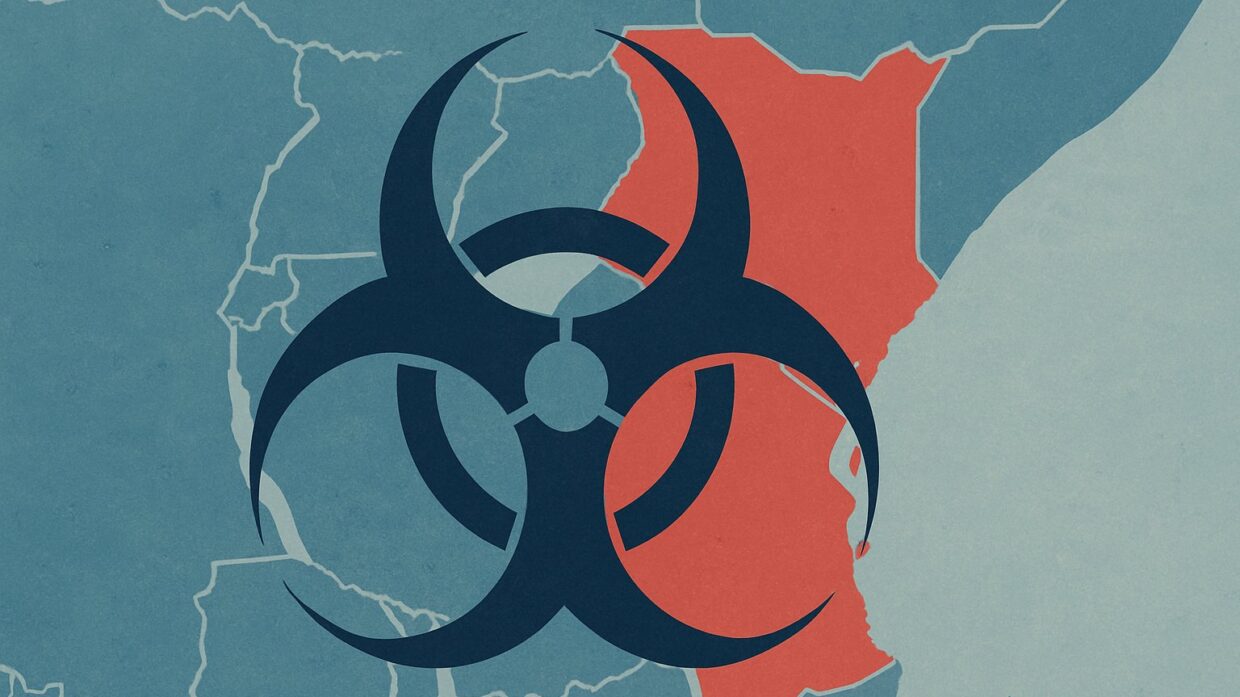
Photo: Well This Is News
Kenya Confirms First Ebola Case as Virus Surges in DR Congo Province
Historically Brutal Ebola Outbreak Crosses Border Into New Country
Kenya Confirms First Ebola Case as DRC Outbreak Continues
Key Takeaways
- Kenya's border health screening detected a symptomatic case, suggesting the system functioned to identify infection, but the timing of detection relative to symptom onset remains unclear.
- The DRC has experienced multiple Ebola outbreaks since 2018, meaning Kenya's first case after five years of proximity suggests either undetected transmission events were already occurring or cross-border spread of infected individuals is genuinely rare.
- Kenya's health response capacity,treatment availability, testing infrastructure, and isolation protocols,has not been documented in coverage, yet determines whether this case remains isolated or signals the start of community transmission.
The Analysis
Kenya's confirmation of its first Ebola case marks a documented milestone in a regional outbreak that has already killed thousands in the Democratic Republic of Congo, but the framing of this event by different outlets reveals what each side chooses to emphasize about disease spread, preparedness, and international coordination.
What actually happened is straightforward: Kenya's health minister announced on Tuesday that a citizen who arrived from the DRC on Saturday died of confirmed Ebola. Kenya identified 28 contacts for monitoring. The DRC is experiencing its largest Ebola outbreak on record, with thousands of infections concentrated in its north-east provinces. This is the second-largest Ebola outbreak globally. The virus has now crossed a national border into a previously unaffected country.
The Guardian's framing uses the word "surges" in its headline and emphasizes the speed of spread through specific geography: "spread rapidly through the north-east." The language foregrounds the outbreak's momentum and scale. The Guardian does not emphasize the cross-border aspect as a failure of containment, but rather as part of a continuing natural progression of an already-large outbreak. The omission here is granular: the reporting does not establish whether Kenya's border health screening failed to detect the case, or whether the individual transited before symptom onset.
The Daily Wire leads with "Historically Brutal" and frames the cross-border transmission as an escalation event. The headline emphasizes the virus "crossing border into new country" as a discrete, concerning development. The framing treats regional spread as a threshold moment. The wire's language choices shift the narrative from outbreak magnitude to outbreak trajectory. What this framing leaves understated is that containment failures in the DRC preceded Kenya's case by months; the DRC outbreak began earlier in 2024, meaning Kenya's case represents not a sudden breakthrough in the virus's transmission capability, but rather the predictable geographic expansion of an outbreak with thousands of existing cases.
What neither side fully addresses is the documented history of Ebola's movement patterns in this region. Ebola does not recognize borders once community transmission is established. The DRC has experienced multiple outbreaks since 2018. The fact that Kenya went five years without a documented case despite proximity to ongoing DRC outbreaks suggests either that transmission events were already occurring undetected, or that cross-border movement of infected individuals is rare despite population movement between countries. The reporting does not establish which. Neither outlet names the specific provinces where Kenya's case originated in the DRC, or whether those areas had documented community transmission chains.
The available coverage also does not foreground what Kenya's health system response actually consisted of: the 28 contacts identified, isolation protocols, testing capacity, or whether Kenya has treatment capacity for severe cases. The Guardian mentions contact identification; the Daily Wire does not. This gap matters because the significance of Kenya's first case depends partly on whether Kenya's health system can contain the case locally or whether this signals the beginning of community transmission.
What the data appears to show is that regional border health screening in East Africa is functional enough to detect at least symptomatic cases, but not so robust that cross-border movement of infected individuals is impossible. Kenya's confirmation is not anomalous; it is consistent with the expected pattern of Ebola diffusion from a region with thousands of cases.
The more honest headline: First confirmed Ebola case in Kenya arrives from ongoing DRC outbreak; 28 contacts identified for monitoring.
Kenya's first Ebola case forces a critical reassessment of East African disease surveillance infrastructure and cross-border protocols that have remained untested against major outbreaks. The case exposes that detection systems caught this particular patient only after symptoms emerged during travel, raising questions about whether asymptomatic or presymptomatic transmission has already seeded undetected chains in Kenya's population. This directly challenges the region's containment assumptions and will drive immediate resource reallocation to border screening and contact tracing in Kenya, Uganda, and Rwanda. If community transmission establishes in Kenya, the outbreak's geographic footprint doubles, fragmenting response efforts across two countries with different health system capacities and potentially straining limited global Ebola treatment resources away from the DRC epicenter. The case transforms from data point to operational crisis only if Kenya's health system cannot isolate transmission locally within weeks.