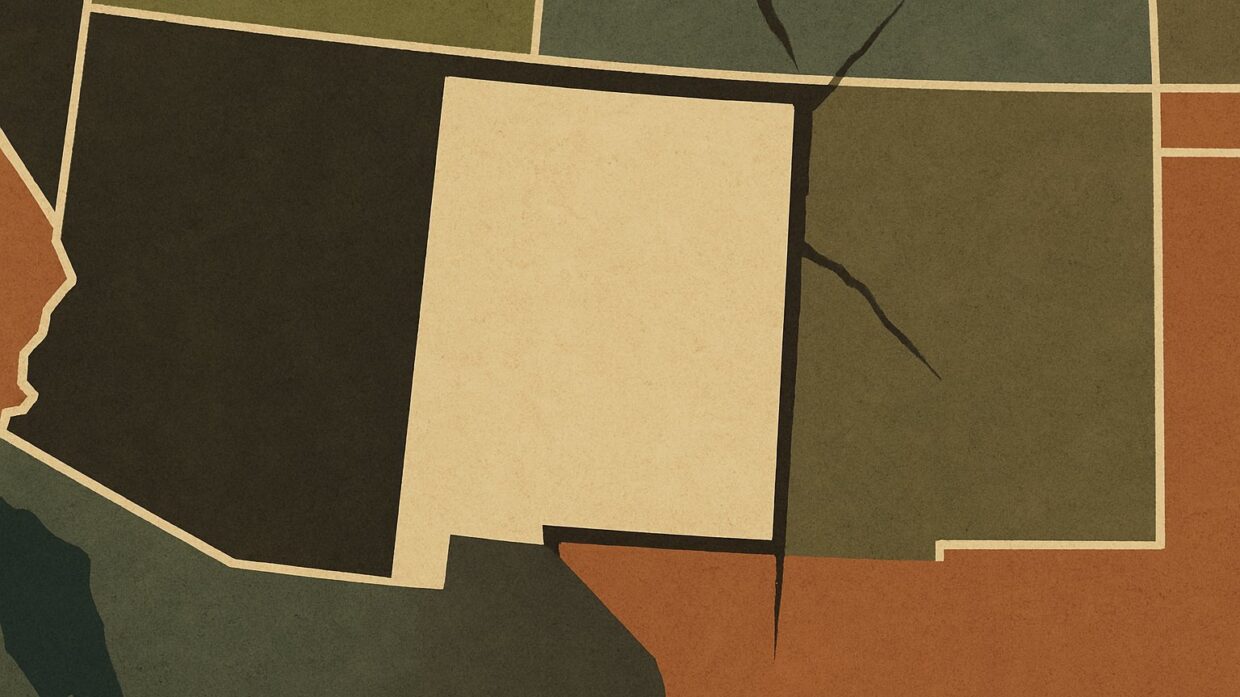
Photo: Well This Is News
Trump Mocks New Mexico With 'New America' Posts as Democrats Defend State's Identity
Trump Floats Name Change for New Mexico Following 'Lake America' Push
Trump Posts Map Renaming New Mexico to 'New America,' State Officials Reject Proposal
Key Takeaways
- Trump has already executed one renaming through executive order on the Gulf of Mexico, but has no constitutional authority to rename a state, which only a state legislature can do.
- The White House never clarified whether the New Mexico posts represented formal policy, political messaging, or rhetorical experimentation, leaving the actual intent fundamentally unclear.
- The core issue both sides missed is whether Trump understands the legal limits on his power to rename states, or whether he is deliberately using performative posts to test how far rhetoric can substitute for executable policy.
The Analysis
Trump posted images on Truth Social renaming New Mexico as 'New America,' and the White House amplified the post, following his earlier executive action to rename the Gulf of Mexico the 'Gulf of America.' The sequence raises a specific question: what distinguishes a policy proposal from performative provocation when neither the power to execute nor the intent to implement is formally established.
The documented facts are narrow. Trump posted a map. New Mexico Governor Michelle Lujan Grisham responded on social media, stating 'New Mexico's name isn't up for debate, it's been ours since before the United States existed.' Democratic leaders in the state characterized the posts as mocking. The White House reposted the image. No statement from Trump's office explained whether this represented a formal policy proposal, a rhetorical gesture, or experimentation with the concept of territorial rebranding following the Gulf renaming.
The left frames this as Trump attempting to erase New Mexico's identity and mock a state he may view as politically hostile. MSNBC's reporting centers Democratic leaders 'aggressively pushing back,' positioning the state as defending itself against federal overreach. The framing emphasizes Trump's deliberate attempt to diminish the state's historical identity. What this framing does not foreground is that Trump has already executed one renaming through executive order, making the distinction between jest and policy intent unclear from the reporting alone.
The right frames this as Trump continuing a pattern of rebranding initiatives, with Fox News and Washington Examiner reporting it as part of a broader agenda that includes the Gulf of America order. The framing presents the posts as part of Trump's administrative priorities. What this framing underemphasizes is any acknowledgment of what authority the presidency actually possesses to rename a state, or whether Trump has articulated a formal mechanism to do so.
What neither side fully addresses is the constitutional question that underlies the entire exchange. States are not federal possessions. A state's name cannot be changed by executive order. It requires action by the state legislature. The actual political implication is not whether Trump will succeed in renaming New Mexico, but what his posting strategy signals about his administration's approach to federalism and state sovereignty. Grisham's response, 'It isn't up for debate,' is correct as a constitutional matter. What is unaddressed across all coverage is whether Trump understands this limitation, whether he is deliberately testing how far performance can substitute for policy, or whether the posts are purely rhetorical theater.
The absence of a formal policy document, a legal framework, or even a clear statement of intent from the White House leaves the story in ambiguous territory. The Gulf of America order showed Trump can execute territorial rebranding through executive authority over federal naming conventions. No equivalent authority exists over state names. This distinction is the actual news.
Trump's posts about renaming New Mexico expose a fundamental gap in how his administration distinguishes between performative statements and actionable policy. While Trump successfully issued an executive order renaming the Gulf of Mexico through federal jurisdiction over marine naming conventions, state names fall outside presidential authority entirely, requiring state legislative action that New Mexico has already rejected. By posting images without clarifying whether this represents formal policy, rhetorical provocation, or testing public tolerance for executive overreach, Trump forces a constitutional question into ambiguity. The real institutional consequence is not whether New Mexico gets renamed, but whether the White House is deliberately collapsing the distinction between performance and governance to normalize claims of executive power that do not legally exist. This pattern suggests an administration willing to blur constitutional boundaries through repetition and amplification, regardless of implementation capacity.