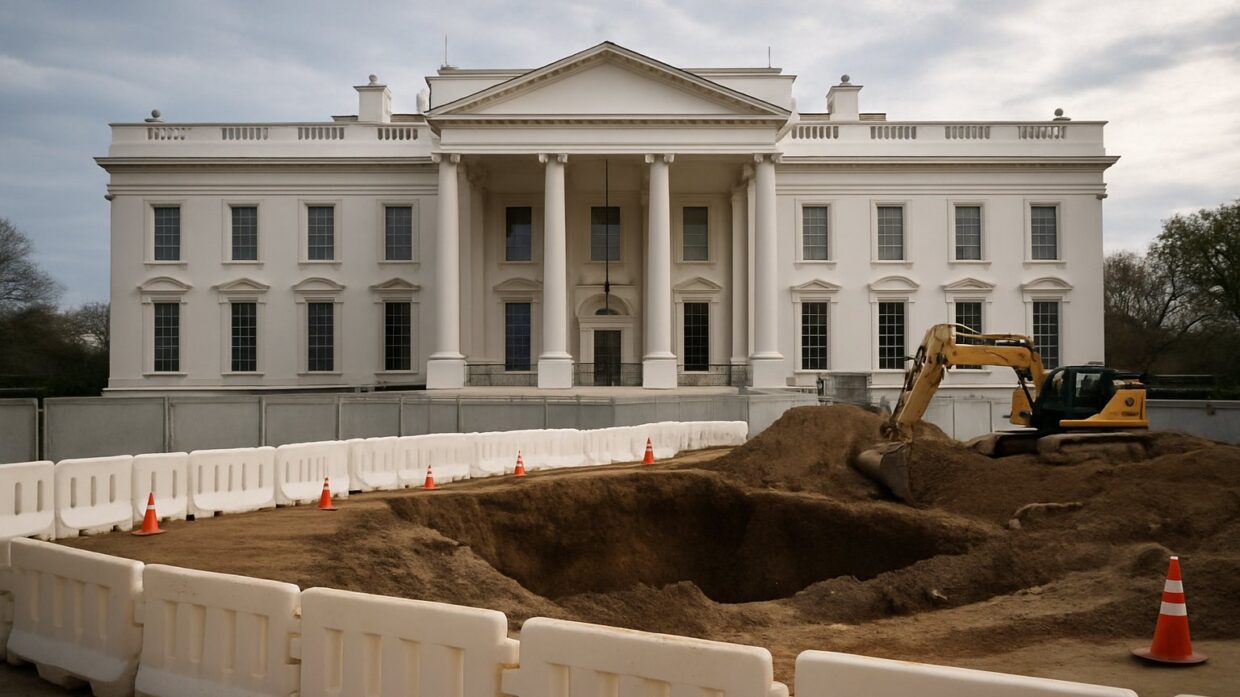
Photo: Well This Is News
Another court blocks Trump's $400M ballroom project, affirms Congress controls White House changes
Trump vows Supreme Court appeal after judges appointed by Obama, Biden halt ballroom construction
Federal appeals court blocks above-ground White House ballroom construction, requiring congressional approval
Key Takeaways
- The court allowed below-ground construction to proceed while blocking above-ground work, suggesting the constitutional dispute may center specifically on visible structural changes rather than executive authority over all White House modifications.
- Neither side has explained what historical precedent actually governed White House building modifications over the past 70 years, leaving unclear whether this is a novel constitutional question or a departure from established practice across administrations.
- The dissenting judge's reasoning remains unreported in media coverage, preventing readers from understanding whether this is a clear constitutional principle or a genuinely close legal call that could plausibly swing either way at the Supreme Court.
The Analysis
A federal appeals court has blocked above-ground construction on a Trump administration White House ballroom project, handing a victory to historic preservation advocates and forcing a constitutional question about presidential authority to the Supreme Court. The D.C. Circuit ruled 2-1 that Congress, not the president, holds constitutional authority over modifications to the White House building structure.
The U.S. Court of Appeals for the D.C. Circuit affirmed a lower court decision in a split decision, with the majority opinion finding that changes to the White House building structure fall under congressional authority, not executive discretion. The panel allowed below-ground construction to proceed. The Trump administration had initiated the ballroom project, estimated at $400 million according to HuffPost and Fox News reporting. Trump announced on Friday he would file an immediate Supreme Court appeal, describing the decision as unjust in a social media post, according to PBS NewsHour.
Left-leaning outlets framed this as a constitutional check on executive power. HuffPost's headline emphasized that the D.C. Circuit "ruled 2-1 that the Constitution gives Congress, not the president, authority over changes to the White House." NPR and MSNBC described the decision as siding with historic preservation advocates, positioning the court as defending established institutional norms against unilateral executive action. This framing emphasizes democratic process and constitutional separation of powers, appealing to concerns about executive overreach. The reporting does not, however, establish what specific prior agreements or regulatory processes governed White House building modifications before this dispute, or whether the administration followed all required procedural steps before construction began.
Right-leaning outlets framed this as judicial overreach by politically motivated judges. Fox News highlighted Trump's argument that the ruling "jeopardizes lives of future presidents" by restricting executive flexibility on security matters. Breitbart emphasized that the judges who ruled against the project were "appointed by former President Barack Obama and Joe Biden," explicitly tying the decision to partisan judicial selection rather than engaging the constitutional merits. This framing treats the separation-of-powers question as secondary to concerns about judicial composition. The right-wing coverage does not, however, explain why Trump administration officials believed the project could proceed without congressional approval, or what legal authority they relied upon to begin construction.
Neither frame addresses what the prior 70 years of White House building practice actually established. The reporting does not establish whether previous administrations sought congressional approval for interior modifications, security upgrades, or structural changes, or whether the 2-1 court split suggests genuine constitutional ambiguity rather than settled law. The dissenting judge's reasoning is not reported in any of these summaries, leaving readers unable to evaluate whether this is clear constitutional principle or close legal call. The fact that the court allowed below-ground construction suggests the issue may be specifically about above-ground visibility rather than executive authority generally, but that distinction receives limited attention across outlets.
What matters here is that this decision now heads to the Supreme Court, forcing the justices to rule on whether the executive branch has independent authority over White House building modifications or whether Congress retains structural control. The institutional implication is significant: if Congress prevails, future administrations lose unilateral power over security upgrades and physical modifications. If Trump prevails, the separation-of-powers principle the lower courts invoked becomes narrower than it appears. The unresolved question is whether either the Trump administration or preservation advocates fully disclosed what specific White House building modifications have been approved without explicit congressional action in prior administrations.
This Supreme Court case will settle whether future presidents can independently modify the White House structure for security purposes or must petition Congress for approval. A ruling against Trump constrains executive autonomy over the building itself, potentially requiring legislative sign-off on any above-ground alterations. A ruling for Trump establishes that the White House occupant controls its physical form, weakening congressional oversight of the residence's evolution. The decision also determines whether "historic preservation" becomes a binding legal constraint on executive discretion at the nation's most secure building, or remains advisory. That outcome reshapes the practical relationship between two branches and establishes which institution controls what Congress arguably owns but the president inhabits and operates daily.