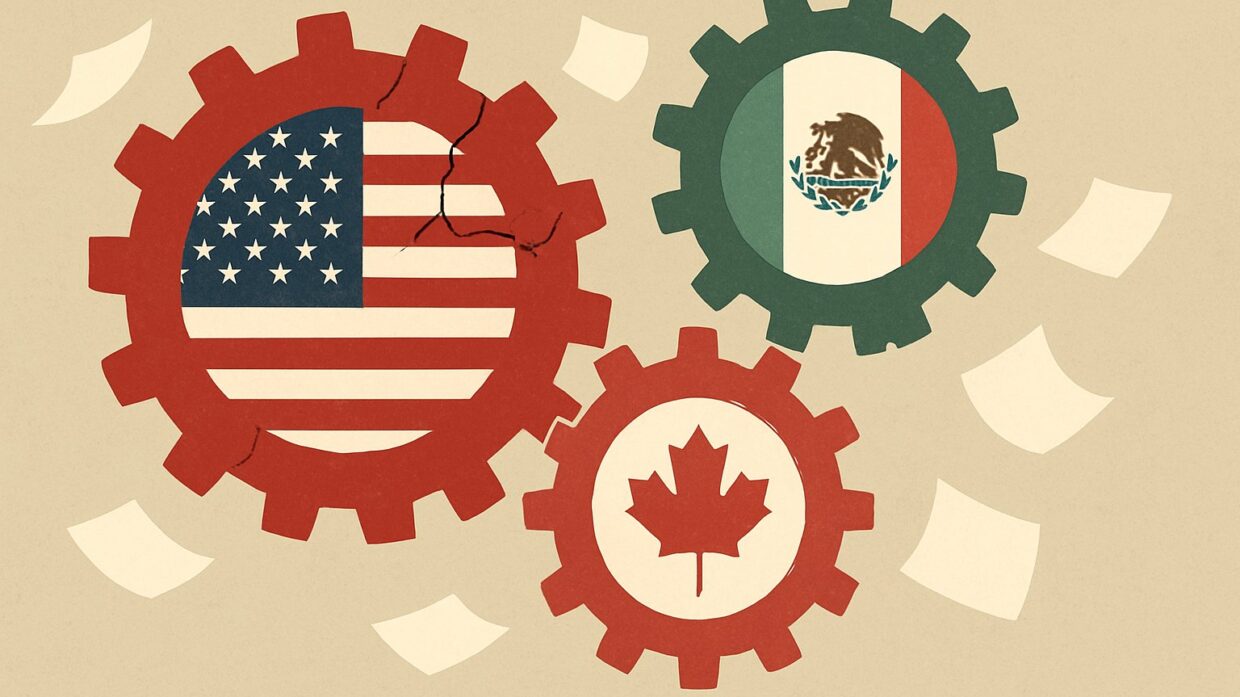
Photo: Well This Is News
Trump Abandons His Own Trade Deal, Replacing Security With Annual Uncertainty
Trump Administration Takes Firmer Stance on Trade Pact, Demanding Regular Reassessment
US Declines to Renew USMCA, Opts for Annual Review Process Instead
Key Takeaways
- The USMCA remains legally in force and will operate for at least another decade regardless of the renewal decision, so the agreement itself is not being terminated despite the framing from both sides.
- The shift from conventional renewal to mandatory annual reviews creates documented business uncertainty for companies operating across North America, particularly in auto parts and agriculture, because tariff protections could theoretically change each year.
- The reporting does not establish whether the Trump administration is dissatisfied with specific USMCA terms, using annual reviews as leverage strategy, or responding to signals from Canada and Mexico about their own renewal preferences.
The Analysis
The Trump administration declined to renew the USMCA trade agreement with Mexico and Canada on July 1, 2026, opting instead for annual review cycles, a decision that maintains the pact's legal framework while fundamentally altering how the three nations manage their trade relationship.
US Trade Representative Jamieson Greer confirmed the decision in statements to Bloomberg News. The USMCA itself remains in force and will continue for another decade unless a country chooses to withdraw, according to the agreement's text. The shift moves from the standard trade pact structure, where renewal happens at defined intervals and provides long-term certainty, to a rolling review process where the arrangement is assessed annually. This mechanism requires affirmative action to maintain the agreement each year rather than automatic continuation absent explicit withdrawal.
The left framing, represented by The Guardian, emphasizes the contradiction between Trump's earlier branding of USMCA as his signature achievement and his current refusal to grant it permanent renewal. The coverage uses the word "refused" and "abandoned" to characterize the decision, framing it as a reversal of Trump's own stated success. What this framing leaves out is that the agreement continues operating and that annual reviews are not inherently destabilizing. It also does not address whether such reviews might align with Trump's stated preference for renegotiating existing trade arrangements or reflect dissatisfaction with specific terms.
The right framing, represented by Breitbart, focuses on the administration's decision to "decline" renewal without editorializing whether this constitutes abandonment. The language is more neutral on its surface, but the coverage implies this is a deliberate choice reflecting negotiating strategy rather than second-guessing. What the right framing underplays is the practical reality: companies operating across North America now face annual uncertainty about whether their primary trade framework will continue, and the costs of that uncertainty.
What neither framing adequately addresses is the structural context. The USMCA was itself a renegotiation of NAFTA, completed in 2018 and implemented in 2020. The agreement includes a mandatory review provision, originally scheduled for 2026, which both sides acknowledged would occur. The Trump administration's decision to use that review as a pivot point toward annual reassessment rather than renewal suggests either dissatisfaction with specific terms or a deliberate strategy to maintain leverage. The reporting does not establish which. The decision also raises an unresolved question about whether Canada and Mexico had signaled resistance to renewal or whether this is a unilateral US shift in approach.
Bloomberg reporting notes the decision "risks adding uncertainty for companies producing goods across North America," a documented concern about supply chain planning. Auto parts, agricultural goods, and manufactured products flow across these borders daily under USMCA tariff protections. Annual reviews create conditions where those protections could theoretically lapse or change.
The real headline is simpler than either side's framing captures: a working trade agreement that both sides have acknowledged will be in place for at least another decade is now being managed through annual assessments rather than renewed conventionally. That change has genuine business implications, but the agreement itself is not being terminated.
Annual review cycles for USMCA inject structural uncertainty into North American supply chains that have reorganized around the agreement's tariff framework. Auto manufacturers, agricultural exporters, and integrated manufacturers now must plan capital investments and production logistics knowing their primary trade rules reset every twelve months rather than operating under decade-long certainty. Companies cannot confidently commit to multi-year facilities or procurement contracts when the foundational tariff environment requires annual affirmation. This forces either conservative financial planning that reduces cross-border investment or acceptance of genuine political risk, neither outcome beneficial to the three economies that have built competitive advantages on USMCA's stability.