Photo: Well This Is News
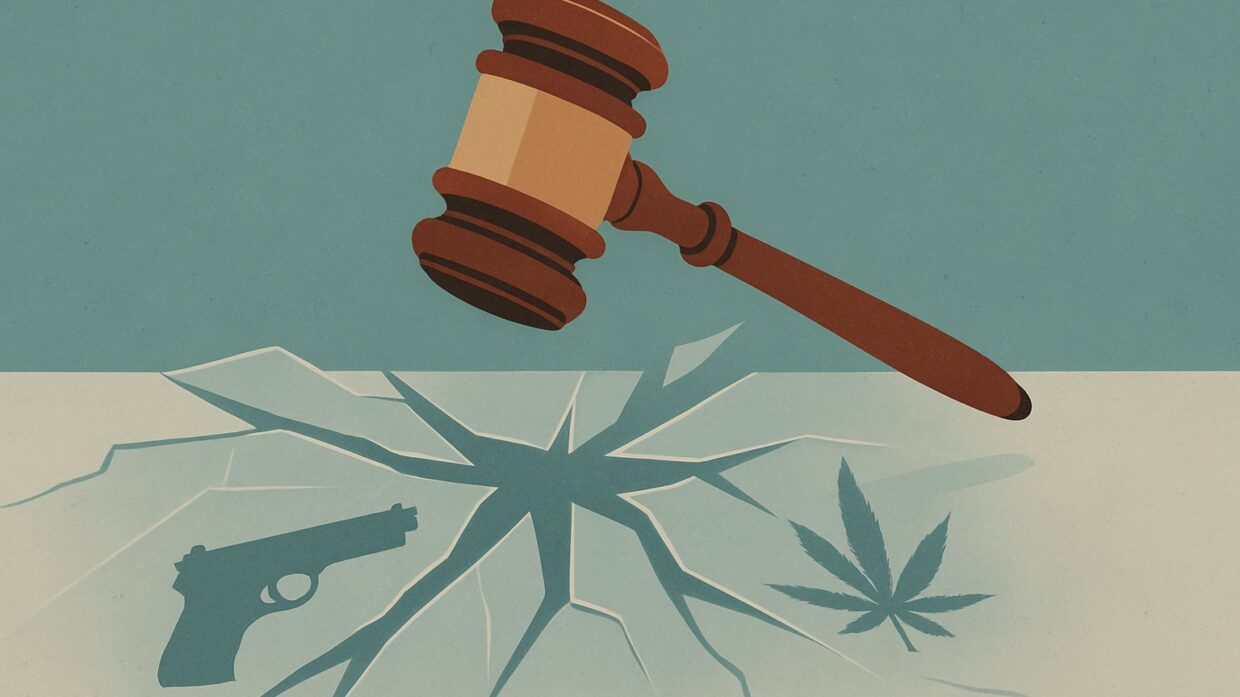
Supreme Court Strikes Down Gun Law That Barred Marijuana User From Owning Firearms
Supreme Court Unanimously Limits Gun Restriction on Drug Users, Constrains Hunter Biden Prosecution
Supreme Court Rules Federal Drug-User Gun Ban Unconstitutionally Vague
Key Takeaways
- Congress retains the power to redraft the statute with clearer language and narrower definitions targeting specific categories of drug use, meaning the Court did not strike down the government's ability to regulate gun ownership by drug users.
- The decision's true doctrinal significance lies in its application of vagueness doctrine to gun restrictions, suggesting the Court will scrutinize how precisely legislatures must write laws that limit constitutional rights, which may extend beyond drug users to other prohibited categories.
- The ruling leaves open major unresolved questions about state-level marijuana legalization and whether a revised federal statute might apply only to certain Schedule I drugs or only to drug distributors rather than all users.
The Analysis
The Supreme Court issued a unanimous decision finding that a federal statute barring illegal drug users from possessing firearms is unconstitutionally vague and cannot be applied as written. The case centered on a Texas man who admitted to regular marijuana use while keeping a firearm for self-defense. What the decision actually established: the law as written fails to provide adequate notice of which drug users are prohibited and in what circumstances, violating due process. The ruling applies across the board, affecting enforcement not just for marijuana but for all controlled substances.
Left-leaning outlets frame this as a win for Second Amendment protections and a check on federal overreach in gun enforcement. NPR's language emphasizes that the law "violated his Second Amendment right" and highlights the vagueness problem as a constitutional deficiency. The framing treats the ruling as fundamentally protective of gun rights and positions it as a constraint on government power to restrict firearms based on drug use. What this framing underplays: the decision does not legalize marijuana use or establish a right to own guns while using drugs. It establishes only that the particular statute as written cannot constitutionally stand without narrowing or clarification.
Right-leaning outlets emphasize the unanimous nature of the decision and its impact on the Hunter Biden prosecution specifically. Fox News leads with "unanimously limits" and names the Biden connection immediately, framing the decision as constraining a tool prosecutors used against the president's son. The Federalist's coverage treats the ruling as a reaffirmation of Second Amendment protections against broad government restriction. What this framing leaves out: the decision does not endorse unlimited gun ownership by drug users. It addresses only the statute's vagueness, leaving Congress the option to redraft the prohibition with clearer language and narrower scope.
What neither side fully captures is the technical constitutional issue at stake. The Court did not decide whether Congress can regulate gun ownership by drug users at all. It decided that this particular statute fails to define with sufficient clarity which categories of drug use trigger the prohibition. Congress retains the power to enact a more precisely drafted version. The decision also does not address state-level marijuana legalization or whether federal drug laws remain applicable in states that have decriminalized cannabis. The ruling creates a narrow window: the existing statute cannot be enforced as is, but a revised statute with clearer definitions and more limited scope remains constitutionally permissible.
The underlying structural question the coverage skips over is whether Congress will redraft the statute, and if so, how narrowly. A revised law might target only users of certain Schedule I drugs, or might apply only to those convicted of drug distribution rather than possession, or might require a more recent pattern of use. The decision leaves that legislative choice open. What this signals about Second Amendment jurisprudence: the Court is willing to invalidate gun restrictions based on vagueness and overbreadth, not just categorical rights claims. That principle may apply beyond drug users to other categories of people currently barred from gun ownership.
The Hunter Biden angle, while politically salient, obscures the real doctrinal movement. The decision does not provide him a path to dismissal or reversal unless prosecutors relied on evidence that falls outside a narrower statute's scope. The case is fundamentally about how precisely legislatures must write laws that restrict constitutional rights, not about whether marijuana use should disqualify someone from gun ownership.
Congress can still ban guns for drug users, but it must do so with precision rather than vague categories. The Court's vagueness rationale opens a broader doctrinal path for challenging other gun restrictions on similar grounds, potentially affecting bans on domestic abusers, felons, and those adjudicated mentally ill if their statutory language proves insufficiently clear. Rather than resolving the drug-gun question, the ruling forces lawmakers to choose: redraft with narrow, enforceable language targeting specific drugs and specific conduct, or concede the regulatory space entirely. The immediate consequence is prosecutorial uncertainty about what conduct falls within the law's reach, but the longer consequence is a strengthened constitutional framework for examining how precisely rights-restricting statutes must be written.