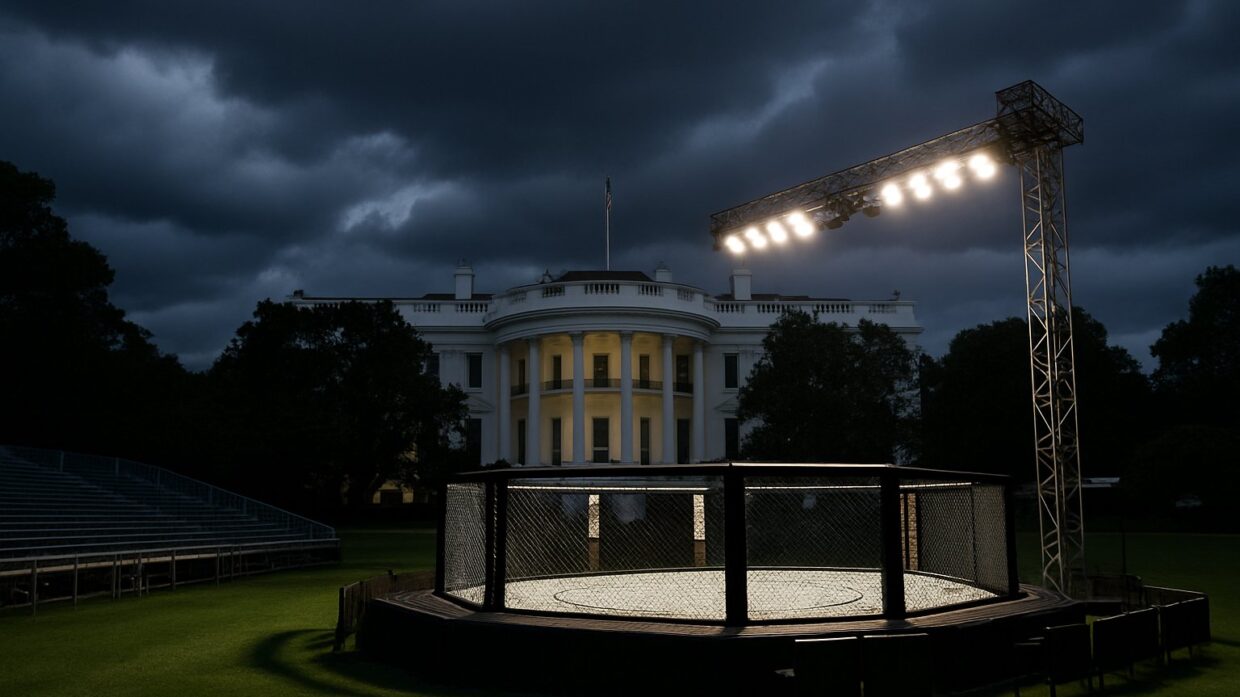
Photo: Well This Is News
Trump Uses 80th Birthday Bash to Celebrate Iran War Deal While Hosting Cage Fights on South Lawn
President Trump Celebrates Birthday With UFC Fights at White House Amid Media Hysteria
Trump Marks 80th Birthday With White House UFC Event and Iran Deal Announcement
Key Takeaways
- Neither left nor right coverage specified the actual terms of the Iran agreement, who negotiated it, what 'initial agreement' means operationally, or how it compares to previous deals.
- The left treated Trump's framing of the agreement as news rather than independently assessing the deal, while the right ignored the agreement entirely in favor of attacking media bias.
- A reader exposed only to left or right sources would know the event occurred and learn what both sides thought about the optics, but would learn almost nothing about what the Iran agreement actually is.
The Analysis
President Trump used his 80th birthday celebration Sunday to simultaneously announce an Iran peace agreement and host a seven-fight UFC event on the White House South Lawn, an unusual convergence that has generated sharply divergent media framing based on what each outlet chose to emphasize and what it omitted entirely.
The documented facts: Trump announced an initial agreement to end the war in Iran during the celebration. The UFC fights, scheduled for Sunday evening, were delayed approximately one hour due to approaching thunderstorms, with UFC prepared to enforce standard 30-minute lightning delays. Seven fights were scheduled to run roughly four hours. Trump's youngest son Barron made a public appearance at the event. NPR, HuffPost, and The Daily Wire all covered the event, with different focal points and descriptive choices.
The left's framing emphasizes the theatrical and unconventional nature of the celebration. NPR's headline pairs 'Iran deal' with 'UFC fights' as parallel accomplishments, using the word 'hailing' to describe Trump's presentation of the Iran agreement. HuffPost describes the event as a 'violent spectacle' and calls it 'strange,' language that signals disapproval rather than neutral reporting. This framing leaves out any substantive reporting on what the Iran agreement actually contains, what its terms are, or how it differs from previous agreements. The left's coverage privileges the spectacle over the policy, which serves a narrative function: it positions Trump as using a serious diplomatic achievement as stage dressing for entertainment.
The right's framing inverts the structure entirely. The Federalist's headline positions media criticism as the actual story, arguing that outlets are hypocritical for criticizing UFC fights while reportedly ignoring 'topless trans twerker' content at other events. This framing leaves out any engagement with the Iran agreement whatsoever. It also does not substantiate the claim about comparative coverage standards or explain what event it references. The right's strategy is not to defend UFC fights on their merits, but to attack media consistency and redirect attention toward cultural grievances entirely unrelated to the birthday event.
What neither side fully captures is the documented sequence of the Iran announcement itself. Neither left nor right reporting specifies: What are the precise terms of this agreement? Which parties negotiated it? What does 'initial agreement' mean operationally, and what would ratification or implementation require? NPR uses the word 'hailing,' suggesting Trump's interpretation, but does not establish what objective observers or Iran analysts assess about the agreement's terms or feasibility. The right does not engage with the Iran agreement at all, treating it as background noise to a culture-war argument.
The institutional question this raises: when a president announces a significant foreign policy development during a birthday celebration, does the novelty of the venue justify deprioritizing the substance of the agreement in coverage? The left chose to cover Trump's framing of the moment rather than to independently assess the agreement's terms. The right chose not to cover the agreement's terms at all. A reader who only saw these sources would learn the event happened and would learn what both sides thought about the optics, but would not learn what the agreement actually is.
The most honest version of this story requires distinguishing between Trump's presentation choices (the UFC event, the venue, the timing) and the substance of what was announced. Those are separable questions. The available coverage suggests that neither side is treating them that way.
Presidential announcements of foreign policy agreements during entertainment spectacles create a structural problem for public understanding that persists long after the news cycle ends. When major media outlets bifurcate coverage into either aesthetic criticism or cultural counterattack, readers never encounter the actual terms of the Iran agreement, what implementation requires, or how independent analysts assess its viability. This pattern establishes a precedent: presidents can announce significant diplomatic developments in unconventional settings while knowing that coverage will fragment into competing narratives about optics rather than substance. The institutional consequence is that future administrations learn that controversial agreements announced at entertainment events will receive coverage organized around theater rather than policy analysis, making the distinction between presentation and substance progressively harder for citizens to evaluate.